A regular Thorough Examination is a vital legal requirement to ensure the safety of materials handling equipment, but it’s crucial to ensure that anyone hired to conduct them is competent, fully understands the process and knows exactly which checks to carry out.
Features
Thorough Examination: who’s the key person?
By
on 01 November 2023
The problem stems from the fact that – unlike the automotive sector – there was never a government-defined testing procedure comparable to the MOT. Rather, individual companies could set up their own procedures and inspection checklists.
That all changed almost 20 years ago, when the two leading bodies in the materials handling sector joined forces to create an accrediting body: CFTS. Its mission, to deliver a national, comprehensive scheme that complied fully with HSE guidelines. A measure of its success is that many hundreds of companies have accredited to CFTS – there are 800-plus accredited depots at the last count – ensuring help is close to hand wherever you are in the UK.
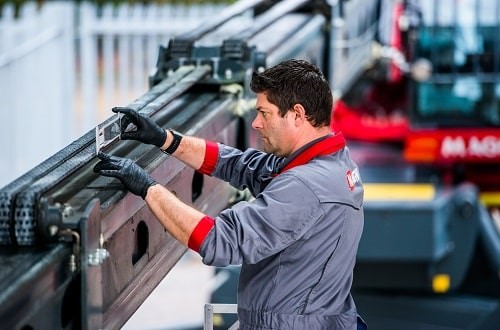 Many hundreds of companies have accredited to CFTS. Photograph: CFTS
However, there are still many unaccredited inspection providers of Thorough Examinations using their own checklists and operating without independent assessment or monitoring. In doing so, the concern is they could well be putting staff working on and around materials handling equipment at unnecessary risk of injury – and employers at greater risk of prosecution.
Ensuring your examinations are thorough and compliant
If you are responsible for overseeing the safe use of materials handling equipment, a good starting point is to review your current arrangements.
Other companies will usually offer, or include, the services of an inspector to undertake a Thorough Examination. This is a default arrangement but you are under no obligation whatsoever to use an insurer’s own inspector and this may not necessarily deliver the best outcome in terms of the quality of the Thorough Examination, or indeed the value-for-money.
If in doubt, check for yourself what’s covered in your current inspection and, ideally, take some practical steps to observe how long your next examination lasts and how thorough the process is.
It will vary according to the size and complexity of the equipment, but inspecting a small, three-wheel electric counterbalance truck should take at least 45 minutes, and a larger truck proportionately longer. It should involve the use of a harness for working at height, truck blocks to secure equipment, ratchet straps for mast and forks, mast blocks, along with more specialised equipment such as chain and fork wear gauges.
Without them, you should be concerned that your handling equipment is not receiving a sufficiently rigorous and comprehensive Thorough Examination.
But that’s not all. If your equipment is used in conjunction with a non-permanent attachment, check whether the examiner employs a separate, dedicated checklist for inspecting it. CFTS-accredited Competent Persons employ a unique 34-point checklist, developed in close collaboration with the UK’s leading manufacturers and distributors of attachments.
 A CFTS-accredited company and its Competent Persons must sign up to a 60-page Quality Assurance Procedural Code. Photograph: CFTS
Independent auditing – checking so you don’t have to
There is growing concern regarding the quality and integrity of some safety inspections since a significant number are not accredited, not audited, and do not conform to a nationally agreed standard.
Indeed, a number of providers – including some big names – are using their own checklists, their own procedures and are not subject to independent auditing. In short, they are marking their own homework.
By contrast, a CFTS-accredited company and its Competent Persons must sign up to a 60-page Quality Assurance Procedural Code covering methods, training, company administration and more. It’s made freely available on the CFTS website so truck users can see for themselves what standards are demanded from accredited companies when it comes to examining expensive, and potentially dangerous, equipment.
So, what are the key indicators you should consider when assessing a Competent Person? What constitutes a Competent Person? Many technicians/engineers have the practical experience to identify dangerous faults, but a fundamental requirement for a Competent Person is that they fully understand the Thorough Examination process and the legal obligations that go with it. Without this knowledge they cannot be competent.
A key point of difference is that CFTS-accredited Competent Persons are required to have five years’ practical working experience on the types of equipment they examine. This is in contrast to other companies whose inspection engineers might not have specific forklift truck knowledge and may only check equipment for general safety purposes as a condition of the insurance cover they offer for its use.
Those practical skills are vital in determining when components need to be replaced in each individual application. The first priority is, of course, to ensure equipment is in safe working order. At the same time though, the experience of the Competent Person can be invaluable in helping customers avoid unnecessary expense from prematurely replacing items that still have plenty of life left in them. It’s often comes down to context and an appreciation of the truck usage, the working environment, etc. In short it calls for knowledge, skill and expert judgement.
 Geoff Martin: "HSE is clear that a Thorough Examination should satisfy the requirements of both LOLER (covering all lifting components) and PUWER (covering brakes, steering, safety systems, etc)." Photograph: CFTS
Meeting HSE guidelines
HSE is clear that a Thorough Examination should satisfy the requirements of both LOLER (covering all lifting components) and PUWER (covering brakes, steering, safety systems, etc). There’s a reason why it’s called a ‘Thorough’ Examination…
Yet, there are still individuals and organisations carrying out this vital, and mandatory inspection process focusing solely on LOLER.
But how can that be a thing, and how did we get here? More importantly, what’s the best way for you, as an employer to ensure your Thorough Examination is fully compliant?
11 ways to evaluate a Thorough Examination
Here’s what CFTS-accredited Thorough Examinations offer:
- Consistency: wherever you are in the country and however many sites you have, each is inspected to the same standard, using the same, extensive checklist
- Competence: examiners have the practical skills, qualifications and specific training to complete a Thorough Examination that meets HSE guidelines
- Traceability – complete audit trail for all aspects and all actions for every inspection
- Experience – all examiners must have served five years as a service engineer in a relevant sector and attended a dedicated course at an approved training centre
- Continuous improvement – every member of a qualified Thorough Examination team, including the inspector, must undergo regular refresher training
- Compliance – meets the latest regulations
- Accountability – backing of accrediting body in case of any disputes
- Regulation – the work of inspectors is routinely inspected to safeguard standards
- Thoroughness – meets all HSE requirements by covering both LOLER and PUWER
- Competitiveness – rates are directly comparable with unregulated examiners
- Authenticity – a Quality Assurance Mark on all materials as evidence of a comprehensive Thorough Examination.
For more information see: thoroughexamination.org
Geoff Martin is Chairman at CFTS