
Suicide rates in England and Wales have hit their highest level in 25 years, prompting mental health charities to call on the Government and employers to do more to prevent people from reaching crisis point.
News
Charities call for government and employers to act as suicide rates reach highest level since 1999
By
on 01 September 2024
Data published on 29 August by the UK Office for National Statistics (ONS) showed that 6,069 suicides were registered in England and Wales in 2023, equating to 11.4 deaths per 100,000 people. This compared with 5,642 registered suicides, or 10.7 deaths per 100,000 people, in 2022, and was the highest suicide rate since 1999.
 Photograph: iStock/AngiePhotos
The Samaritans charity described the figures as “shocking” and has urged the Government to treat suicide as a “public health crisis”, as it has with smoking. The Labour Government recently confirmed that it was considering banning smoking in some outdoor spaces in England, building on plans announced by the previous Conservative government to gradually outlaw the sale of tobacco so that anyone born from 2009 onwards would never be able to purchase it legally.
“The Autumn budget is the chance for this Government to break its silence and commit to proper investment for suicide prevention with the same ambition that we have seen drive down smoking rates,” said Jacqui Morrissey, assistant director of influencing at the Samaritans. “These figures are the final wake-up call: suicide is preventable, but not without real action.”
The ONS figures showed that the highest suicide rates in England and Wales were among men, where the rate was 17.4 deaths per 100,000 people in 2023 – up from 16.4 deaths per 100,000 in 2022. The rate rose to 25.5 deaths per 100,000 for males aged between 45 and 49.
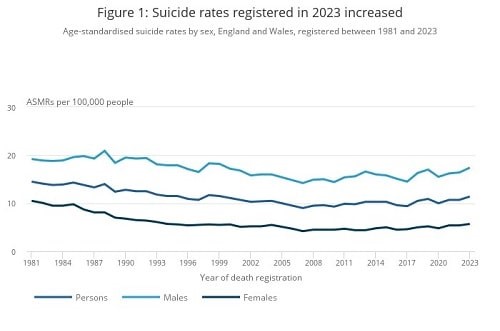 Source: Suicides in England and Wales from the Office for National Statistics
The suicide rate for females in England and Wales increased to 5.7 deaths per 100,000 from 5.4 deaths per 100,000 in 2023, with the 50-54 age group most affected.
British Safety Council’s sister charity, Mates in Mind, which promotes the development of positive mental wellbeing in the workplace – with a focus on construction as well as sectors including transport, logistics and manufacturing – advocates for building a culture of prevention, to help ensure that people can receive mental health support before they reach crisis point.
“Organisations have a key role to play in this, not least because they have a legal duty of care to ensure the health, safety and wellbeing of their employees,” said Mates in Mind managing director Sam Downie. “We believe that implementing a continuous and comprehensive approach can help reduce the likelihood of individuals reaching a crisis point, as supporting positive mental health in and through work becomes an integral part of everyone’s role.
“Working together, as individuals, employers, communities and government, we can make work good for mental health, generating change that benefits the workers of the future.”
Samaritans helps people struggling with mental health issues and suicidal thoughts. The charity can be contacted by telephone free-of-charge on 116 123, or by email at [email protected].
To read more about the work of Mates in Mind, see:
World Suicide Prevention Day is on 10 September 2024. For more information, see:
matesinmind.org/training-and-resources/world-suicide-prevention-day-2024
NEWS
British Safety Council calls on UK Government to ban silica-containing materials
By on 20 August 2026

Network of welfare hubs for Hyderabad gig workers planned by entrepreneur
By Orchie Bandyopadhyay on 14 August 2026
A well-known Indian entrepreneur-turned-investor is set to launch the first of what he hopes will become a chain of subscription-based community welfare hubs providing rest and related facilities for the nation’s ever-growing gig workforce.
Mates in Mind launches free suicide prevention training for construction workers
By on 13 August 2026