
Sitting has been called the new smoking, and now professors have come up with a more helpful analogy to beat our addiction to the seat – movement snacks.
News
Take ‘movement snacks’ to reduce health risks from desk working, say experts
By
on 31 July 2025
This refers to changing our posture regularly throughout the day to mitigate the health impacts of long sitting duration.
“There isn’t an ideal perfect posture that we all need to be adopting which will mean we never have any musculoskeletal issues,” said Dr Chris McCarthy, associate professor at Manchester School of Physiotherapy, who was a guest on Radio 4’s Sliced Bread programme yesterday
“We can be [sitting] in what the ergonomic society will have us believe is a perfect posture but if you stay eight hours in that position you’ll get back pain and neck pain. What’s more important than a static posture is variability.”
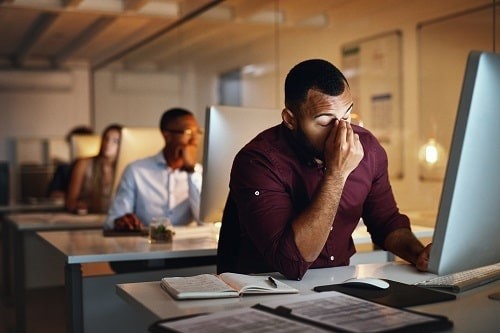 Office workers spend up to 10 hours a day sitting, including sitting at work and leisure time after. Photograph: iStock
Speaking on the programme which debated the merits of sit-stand desks, he said: “It’s about injecting movements snacks – or breaks – into the day, so you get this variability throughout the day.”
The UK population is around 20 per cent less active than in the 1960s according to government guidance. If current trends continue, we will be 35 per cent less active by 2030.
Evidence suggests that people who sit for eight or more hours a day have increased risk of health issues including heart disease, type 2 diabetes and premature mortality.
Office workers rack up 10 hours of total sitting time on average, including sitting at work and leisure time after.
Stacy Clemes, Professor of Active Living and Public Health at Loughborough University, also a guest on the programme, said there is now quite ‘robust evidence’ of substantial health risks associated with prolonged sitting. “Our lifestyles have become more sedentary due to conveniences of modern living, increased technology in the workplace and at home, so we are certainly becoming more sedentary and that does seem to be detrimental to our health.”
The professors advocated for sit-stand desks overall, saying they could help introduce movement and to break up sitting for computer-based workers. “They can be effective in helping people sit less, but don’t feel you have to stand all the time,” said Clemes. “The best things you can do are to alternate posture.”
The debate follows the government’s Inquiry into the effects and future development of remote and hybrid working in the UK.
One recommendation it heard was that ‘organisations should develop comprehensive risk assessments for health behaviours (e.g., physical inactivity, sedentary behaviour) associated with working from home. Specific consideration should be given towards ergonomic workstations and necessary equipment to support employee musculoskeletal health, as well as breaking up prolonged periods of sitting time, increasing movement, and supporting mental health.’
Over half a million, or 543,000 workers, are suffering from work-related musculoskeletal disorders according to HSE, with keyboard work accounting for 11 per cent of these.

NEWS
British Safety Council calls on UK Government to ban silica-containing materials
By on 20 August 2026

Network of welfare hubs for Hyderabad gig workers planned by entrepreneur
By Orchie Bandyopadhyay on 14 August 2026
A well-known Indian entrepreneur-turned-investor is set to launch the first of what he hopes will become a chain of subscription-based community welfare hubs providing rest and related facilities for the nation’s ever-growing gig workforce.
Mates in Mind launches free suicide prevention training for construction workers
By on 13 August 2026