
An exciting line-up of speakers presented at the British Safety Council’s 13th annual conference, which took place virtually on 17 October.
News
British Safety Council conference: resilience in a changing world
By
on 18 October 2023
Talks were connected to the event’s theme – how organisations can stay ahead of the curve and remain resilient in a rapidly changing world.
Nathan Baker, chief executive of the Institute of Occupational Medicine and conference chair, gave the opening address. He shared a raft of eye-opening statistics, not least that companies are 23 per cent more profitable if they look after their people. “100 times more people die to a health-related issue than work-related accidents,” he said. “There is a direct, human cost to not managing our workplaces properly,” he stressed.
Tunde Agoro, director of ESG at RPS Consulting Group joined a panel session on global developments in sustainability, and what these mean for businesses. He explained the ‘why’, ‘what’, ‘when’, ‘who’ aspects of sustainability. “The case is clearly established [as to why],” he said. “We have a climate emergency, an existential crisis – we have to act now.” As for when, organisations should set interim targets to adhere to the UK’s 2050 net zero target. “Break the problem into manageable bite sizes, it helps to know [you] are on the right track.”
Dominique Goncalves, sustainable finance advisor at Pinsent Masons, spoke of the “push and pull” effect of businesses reporting to their investors on sustainability and fund managers demanding more from sustainability credentials when choosing their portfolios.
We returned after a break to hear Morgan Lobb, chief executive officer of VERCIDA and Katy Bennett at PwC discuss diversity and ageism in the workplace. We learned that older workers are today’s workplace disruptors – women over 50 are the fastest-growing working population in the UK and there are more over 60s than over 16s in the workforce today. “We have the most multi-generational workplace now than ever,” said Lobb. It also explains perhaps why menopause has become such a talking point. “This group [is] driving things,” said Bennett.
Marcus Herbert, head of wellbeing at British Safety Council led the session “in search of the North Star of workplace wellbeing”. Herbert had some good tips for managing people well. These included owning your mistakes with the team, inviting feedback and being open to ideas: “When presented with an idea, consider is it wrong or just different to my ideas?” he offered.
Then it was on to Modern Slavery – How can you be an advocate of change? with Dr. Julie Riggs and Phil Pinnington, both at the British Safety Council. They picked out a couple of relevant sustainable development goals from the UN’s list of 17: good health and wellbeing and decent work. Clearly there is much expected of us and there’s much more we can do.
How can we deal with air pollution as a “Wicked Problem?” was the focus of the talk led by Professor Sir Stephen Holgate CBE, clinical professor at the University of Southampton. Holgate shared latest research and Alastair Lewis, professor of atmospheric chemistry at the University of York looked at how we can make things better. He urged businesses to see the problem as “more than just exhaust pipes and lorries” but also, how we use our buildings and source our materials.
Developments in education around health, safety and wellbeing brought together Dee Arp, chief operating officer at NEBOSH and Peter Kelly, founder of Being Real for a wide-ranging discussion. When Kelly started out working on a neuro-psychology unit in Liverpool many years ago his “utopian vision would’ve been a society that understood mental health at work”. Although we’ve achieved a lot more awareness, support is still focused on the individual: “We’re not tackling the source [of problems].” Arp agreed: “It shouldn’t be this difficult,” she said. “Good health and wellbeing is about creating an environment where people feel valued and they trust. It’s not complex.”
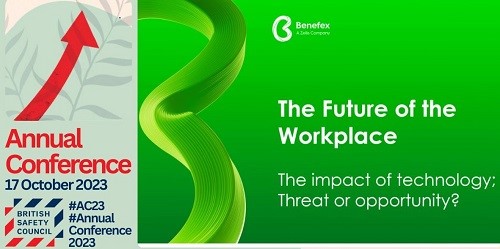
A stimulating session closed the day with Gethin Nadin, chief innovation officer at Benefex who looked at the impact of technology, such as AI, cobots, and the metaverse. The argument goes that technology makes us more productive and safer. It can also be destructive: “[Teams notifications], etc enable multi-tasking, but that’s not good for productivity or wellbeing,” he said. Will technology be a friend or a foe to productivity and wellbeing? The jury was out, but he gave us much food for thought.
NEWS
British Safety Council calls on UK Government to ban silica-containing materials
By on 20 August 2026

Network of welfare hubs for Hyderabad gig workers planned by entrepreneur
By Orchie Bandyopadhyay on 14 August 2026
A well-known Indian entrepreneur-turned-investor is set to launch the first of what he hopes will become a chain of subscription-based community welfare hubs providing rest and related facilities for the nation’s ever-growing gig workforce.
Mates in Mind launches free suicide prevention training for construction workers
By on 13 August 2026