An investigation into the cause of a fire in a block of flats in Dagenham will be “protracted” and complex, London Fire Brigade commissioner Andy Roe has said, amid reports that the building was in the process of having non-compliant cladding removed.
News
Role of cladding to form part of Dagenham flat fire investigation
By
on 01 September 2024
The fire broke out in the early hours of 26 August. A total of 40 fire engines and 225 firefighters tackled the blaze on Freshwater Road in Dagenham, which affected the whole building, including scaffolding surrounding the property and the roof, said London Fire Brigade.
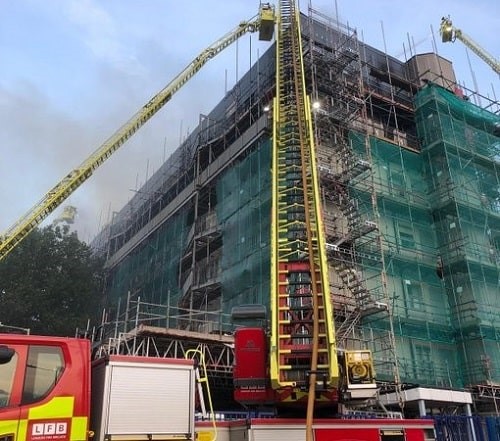 Fire broke out in the early hours of 26 August at a block of flats in Dagenham. Photograph: London Fire Brigade
More than 100 people were evacuated from the building, four of whom were treated at the scene by London Ambulance Service. Two people were taken to hospital due to smoke inhalation.
“We have commenced a full and detailed investigation into the cause of this fire, and we are working closely with police colleagues. However, due to the extensive damage to the building with parts of it now being declared unsafe, access may be limited,” said Commissioner Roe. “This will be a protracted investigation and our fire investigation and fire safety officers are likely to be on scene for several days.
“We know there will undoubtedly be concerns around potential fire safety issues, and this investigation will be a priority for our officers over the coming weeks.”
The building had “a number of fire safety issues known to London Fire Brigade,” Commissioner Roe noted.
A London Fire Brigade spokesperson confirmed to Safety Management that the role of cladding would form part of the investigation. According to media reports citing a planning application document, the building was undergoing works to remove “non-compliant cladding” on the fifth and sixth floors at the time of the incident.
The Fire Brigades Union said the Dagenham fire highlighted the “national scandal of flammable cladding,” with the incident occurring in the week prior to the publication of the Grenfell Tower Inquiry’s final report on 4 September.
The fire at Grenfell seven years ago killed 72 people and drew attention to flammable cladding and its role in enabling fires to spread more rapidly. Work is underway to remove unsafe cladding from thousands of buildings across the UK, but critics say it is not happening quickly enough.
Commenting on the Dagenham fire, Matt Wrack, general secretary of the Fire Brigades Union, said: “Once again, a fire has erupted in a residential building wrapped in flammable cladding. There needs to be an urgent and swift investigation of how this has been allowed to happen.
“Hundreds of thousands of people continue to live in buildings like it, with various failings in fire safety. This is a national scandal.”