
Traditional safety risks have been prioritised over workers’ health for too long and there needs to be a “fundamental shift” towards preventing employees from becoming ill through their work, according to Health and Safety Executive (HSE) chair Sarah Newton.
News
HSE chair calls for ‘fundamental shift’ towards preventing work-related ill health
By
on 23 January 2025
In a presentation at the SHW Live event in Manchester on 22 January, Newton said that work-related ill health was a key area of focus for the regulator. She highlighted recent HSE figures which revealed that 1.7 million workers reported they were suffering from work-related ill health in 2023/24 – almost half of which related to stress, depression or anxiety – while 33.7 million working days were lost due to illness or injury.
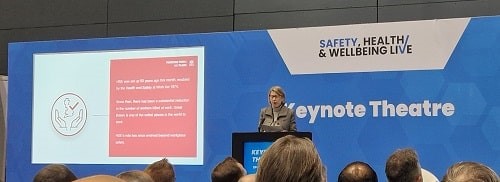 HSE chair Sarah Newton: “It’s about taking effective steps to support employees and create healthier workplaces where people can thrive.” Photograph: British Safety Council
“This human cost demands action,” said Newton, adding that “for too long, we have prioritised traditional safety risks over health” and a “fundamental shift” was required to address the issue. That shift will involve three actions from employers: carrying out risk assessments to control workers’ exposure to stress-causing activities; transforming the way in which mental health is approached in the workplace; and revolutionising the approach to health surveillance.
HSE will use “the full range of regulatory levers” to help with the shift, said Newton, but the “most effective way” of delivering change will be through collaboration with businesses. She highlighted HSE’s Prevention Summit last year, which saw “leaders sharing innovative solutions” they had applied within their different industries to prevent people from becoming ill through their work, and to protect workers from exposure to risks of ill health.
“The challenge ahead is substantial, but we’ve overcome similar challenges before,” said Newton. “It’s about taking effective steps to support employees and create healthier workplaces where people can thrive.”
The HSE chair urged employers to take three actions – the first of which is to provide “suitable” health surveillance for workers. The specific type of health surveillance to put in place will vary business to business and is an “ongoing conversation”. Secondly, businesses should look closely at how they approach work-related stress, while the third step involves committing to share best practice with other companies operating in the same sector.
Cross-sector collaboration and working with stakeholders is a “key element” of HSE’s strategy to address ill health in the workplace, said Newton, in order that “we understand the challenges our duty holders are facing”.
On the topic of mental health, Newton said that “as a society, we’ve made a lot of progress” on being able to talk more openly about it. Many business leaders also now recognise the importance of mental health, she added. However, “the conversation is very much focused on wellbeing after things have gone wrong”, whereas “what we’re more interested in is prevention”.
A record 2.8 million people in the UK are economically inactive due to ill health. Preventing workers from leaving in the first place is key because if people fall out of work for long periods as a result of ill health, it can become more “difficult” for them to re-join the workforce, said Newton.
She encouraged businesses to consult HSE’s updated toolkit to find ways of preventing exposure to work-related ill health risks, and to look at the regulator’s Working Minds website.
NEWS
British Safety Council calls on UK Government to ban silica-containing materials
By on 20 August 2026

Network of welfare hubs for Hyderabad gig workers planned by entrepreneur
By Orchie Bandyopadhyay on 14 August 2026
A well-known Indian entrepreneur-turned-investor is set to launch the first of what he hopes will become a chain of subscription-based community welfare hubs providing rest and related facilities for the nation’s ever-growing gig workforce.
Mates in Mind launches free suicide prevention training for construction workers
By on 13 August 2026