
The largely female workforce in India’s garment manufacturing industry faces long hours, low wages and poor working conditions, and campaigners say it is time the Indian government and international clothing brands took tougher action to improve working conditions, pay and employment rights.
Features
The price of fast fashion is not pretty
By
on 11 December 2025
For Reema, the true cost of fast fashion is paid in sweat, suffering and enduring unsafe conditions, as she works long hours for minimal pay inside a cramped garment factory in Noida, Uttar Pradesh.
Reema receives her wages in cash, and she does not receive a paper or electronic salary slip or record, making it difficult for her to raise any complaints if she feels she has been underpaid. However, despite her poor pay, hazardous and difficult working conditions and the precarious nature of her employment, she does not ask the factory owners for better working conditions or a written contract of employment.
“I have a job with or without an agreement. That’s what matters,” she says emphatically.
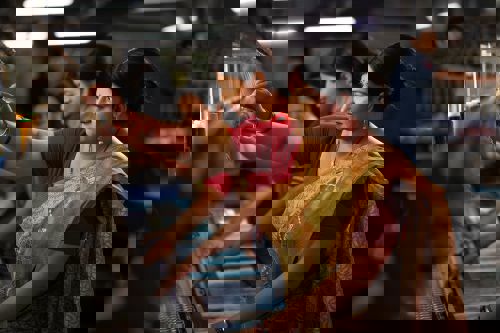
Reema faces significant financial and personal challenges, with three young children in school, an ailing husband (who is unable to work), and an elderly widowed mother. As a result, her family depend on the
Rs 12,500 salary she earns each month, and quitting her job is therefore not an option.
When Reema works overtime, she is rarely paid for the extra hours, and if she is forced to take time off – for example, for a medical appointment – the missing hours or days must be taken as unpaid leave. This is despite the fact the Factories Act of 1948 – which sets minimum legal requirements for working conditions in garment factories – mandating annual paid leave for workers who have been in the employment of the business for 240 days or more in a year. However, many workers in the apparel industry do not receive paid leave.
Devi, another female worker employed in the apparel manufacturing sector, says she knows that she’s being exploited. “I know and so do all the other workers here in this factory,” she explains. “Our freedom is restricted, we have no health insurance or worker rights, and we’re watched by cameras every moment. But like many of my co-workers, we don’t have other options. We keep going.”
Systemic violations of workers’ rights
A recent study by the Fair Trade Advocacy Office (FTAO) and Change Alliance, entitled Beneath the Seams: Women, Garment Work and the Cycle of Exploitation, revealed systemic violations of workers’ rights in India’s garment manufacturing industry, particularly in Tamil Nadu and Delhi NCR.
The study documented the prevalence of exploitative working conditions in factories producing garments for major international brands, including low wages, forced overtime, and gender-based discrimination. Many women reported verbal harassment, unsafe workplaces and denial of freedom of association. Several workers faced retaliation and dismissal for raising concerns, while low wages and long hours perpetuated cycles of economic vulnerability.
The report also highlighted occupational health risks, including inadequate ventilation and sanitation facilities, and the psychological stress from production pressures while working under precarious employment arrangements.
At the same time, rising temperatures – driven by climate change, according to the United Nations’ Intergovernmental Panel on Climate Change – look set to pose an increasing threat to the safety and wellbeing of India’s factory workers, including people employed in garment production sites.
A recent study focused on identifying and assessing the effectiveness of scalable, sustainable and low-cost cooling strategies that could improve the health, wellbeing and productivity of workers in Bangladesh’s garment factories – but relevant to India and Vietnam – concluded that extreme heat and humidity is becoming a serious threat to the health, wellbeing and productivity of garment workers.
The Rana Plaza factory disaster in Bangladesh in 2013 brought into stark public focus the scale and nature of worker exploitation in the garment industry in Southern Asia. The disaster, which occurred when a poorly constructed eight-story commercial building in Savar, a sub-district near Dhaka, collapsed, was the deadliest industrial incident in the history of the global garment industry, resulting in the deaths of 1,134 people and leaving over 2,500 others injured.
Denial of key labour rights
Meanwhile, Amnesty International warns that governments, factories and global fashion brands are profiting from the continued repression of garment workers and the denial of their key labour rights in Bangladesh, India, Pakistan and Sri Lanka, according to two companion reports released recently.
The reports – Stitched Up: Denial of Freedom of Association for Garment Workers in Bangladesh, India, Pakistan and Sri Lanka and Abandoned by Fashion: The urgent need for fashion brands to champion worker rights – document widespread anti-union practices in the garment industry in south Asia, manifesting in repeated instances of abuse of workers’ rights, along with harassment and violence towards workers by employers.
“An unholy alliance of fashion brands, factory owners and the governments of Bangladesh, India, Pakistan and Sri Lanka is propping up an industry known for its endemic human rights abuses,” said Agnès Callamard, secretary general of Amnesty International. “By failing to ensure that the right of garment workers to unionise and collectively bargain is respected, the industry has thrived for decades on the exploitation of a grossly underpaid, overworked and mostly female workforce.”
Callamard added: “This is an indictment of the entire business model of the garment industry which sacrifices the rights of garment workers in Bangladesh, India, Pakistan and Sri Lanka in the relentless pursuit of profits for the shareholders of largely western fashion companies.”
However, as well as poor wages, poor working conditions and barriers to joining trade unions, garment workers are increasingly facing the prospect of unemployment, as international trade tariffs begin to affect the Indian economy. Two months after the US imposed 50 per cent import duties on Indian clothing, businesses in major apparel manufacturing hubs are laying off workers, reducing factory operating hours and introducing indefinite furloughs for large groups of workers. In Noida, where the apparel sector is valued at Rs 50,000 crore, factories are cutting costs, stalling production and telling workers to “come back once things in America get better”.
In Tiruppur in Tamil Nadu, a major apparel manufacturing hub, job losses and factory shutdowns are on the rise as export orders shrink, leaving thousands of workers, especially women, facing serious financial consequences.
Meanwhile, Rukmini VP, president of India’s Garment Labour Union (GLU), warns that although under national wage legislation, the minimum wage employers pay to staff must be revised every three to five years, in many states and Union Territories wages have remained stagnant for over a decade. “Revisions [to wages] are rarely implemented,” she states. “They are frequently challenged by factory owners, who often resist the wage revision with court cases.”
Poor wages
Rukmini adds that wages in the garment, leather, spinning and textile manufacturing industries remain among the lowest in India, ranging from Rs 8,000 to Rs 12,000 per month. In a recent interview with Fashion Revolution, a global fashion activism movement that campaigns for the apparel industry to value people over growth and profit, Rukmini said that despite Indian employment laws limiting the maximum working week to 48 hours, it is not uncommon for garment sector workers to work nine to 11 hours per day, with working hours increasing to as much as 14 to 16 hours per day during peak periods.
“Workers are [often only] allowed a maximum of 30-minute break, and even this is contingent on meeting punishing production targets of 150-200 garment pieces per hour,” she told Fashion Revolution.
Labour rights campaigners also warn the garment sector’s predominately female workforce faces a heightened risk of harassment and bullying from the generally male factory management teams and owners.
In a separate interview with Arisa (Advocating Rights in South Asia), a campaign group that seeks to expose human rights and labour abuses in sectors like the apparel industry in India and other Asian countries, Rukmini stated: ‘About 85 per cent of factory workers in garment factories are women, but the management is mainly made up of men. Female garment workers experience enormous levels of harassment and abuse in the factories, including bullying, sexual and verbal harassment, and threats. Many women use factory-organised transport, but the drivers are often drunk and harass the women.
She added: “There is also discrimination between factory workers in different positions: for example, the crèche is only accessible to children of tailors and not to those of other garment workers. A large part of the female employee workforce feels uncomfortable but do not dare to speak out.”
Difficulty joining trade unions
Campaigners add that workers find it difficult to join trade unions that could fight on their behalf to improve employment rights and conditions, alleging that factory owners and the brands that purchase apparel from countries like India employ a variety of tactics to prevent unions operating in the garment sector.
Aastha Jain, a former policy researcher in Fashion Revolution’s Fashion Transparency Index Working Group, says her own research with union representatives suggests that less than four per cent of workers in India’s apparel industry are union members. She added that the factories – and the brands that purchase apparel from them – employ “extreme” measures to suppress workers from organising, “including targeting the workers, surveillance, economic intimidation, stopping purchase orders (stop sourcing from that vendor), terminating employment, and threatening organisers”.
“Management is always aware when someone in their factory is unionised, with negative consequences,” Rukmini VP, president of the GLU union, told Arisa. “Not one factory is happy with [having] union members.”
However, despite the reported difficulties around organising and campaigning for better workplace conditions, garment workers and employment rights campaigners are nonetheless coming together to highlight poor working conditions and pressure employers and the state and national governments to do more to improve the working lives of workers in the sector.
On 1 November 2025, nearly 350 garment workers assembled at an outdoor auditorium in Bengaluru to publicly unveil a memorandum to employers demanding free nutritious lunches and improvements to welfare facilities in garment factories in Bengaluru and Ramanagara in Karnataka state.
The protest was organised by Munnade Social Organisation, a Bengaluru-based support group for garment workers, and Cividep India, a campaign group that advocates for better employment rights and working conditions for people employed in Indian factories that supply global supply chains.
It followed the publication of a report by Cividep India, Dietary Diversity and Possible Nutrition Status, which found that most workers in the apparel industry were consuming a poor-quality diet, with limited consumption of green leafy vegetables, fruits, and protein-rich foods. The research found this was likely to result in micronutrient deficiencies, such as insufficient iron and folate levels, and the impact on worker health from the nutritional deficit was most likely aggravated by long working hours and poor wages.
During the public meeting, workers from various factories in Bengaluru and Ramanagara called for the immediate provision of free, healthy meals at work, upgrades to factory canteen facilities and universal access to free and safe drinking water in the workplace.
Previously, between 2022 and 2024, Cividep India undertook a two-year-long study to understand women’s working conditions and labour rights in the ready-made garment sector in the cities of Bengaluru and Mysuru in Karnataka state.
“We followed the lives of 184 women garment workers (both intra-state and inter-state migrants), tracing their lives from their natal homes to their matrimonial households and workplaces,” said a Cividep India spokesperson.
“We observed how the demands of women’s labour in the factory and at home impact their physical and mental wellbeing, due to low wages and a hugely stretched workday combining factory work, additional work and housework.
“Women workers spend a total of 9–10 hours in a gruelling work environment in factories and then expend another 5–6 hours of labour within their homes. In addition, sometimes, women spend another two hours doing an additional job to supplement their income.”
The research also found that the low salaries paid to female garment workers mean they struggle to pay for quality education for their children, who also eventually find themselves in irregular, low-paid informal work as adults, continuing the cycle of poverty.
“The narrative reveals how women workers and their families struggle to educate the next generation, who are often found to join the low-wage urban workforce, illustrating the continuation of informal, low-wage labour across generations,” said Deepika Rao, executive Director of Cividep India.
Governments and brands need to do more
Speaking to Arisa, GLU president Rukmini VP, said the Indian government, the governments of countries that purchase apparel made in India, and international garment brands that purchase clothing made in locations like Asia all need to do more to end the exploitation of garment workers in India.
“Brands need to take more responsibility for the situation of workers in the factories they buy from,” she stated. “They make the maximum profit and are constantly looking for cheap labour. They spend a lot of money on audits and also write in their reports and annual reports about union freedom and how they encourage it. But nothing happens in the factories. That is why companies must have discussions with trade unions. That dialogue does not take place now, and there is no stipulation that this must be done.
“Brands claim they do not have the mandate to talk to unions, but that is not true.”
Rukmini added that governments and consumers around the globe who purchase clothing made in regions like Asia also have a major role to play in improving the lives of garment workers in India and other developing countries.
“Governments in consumer and production countries must implement and comply with labour rights laws,” she stated. “There is already a lot of regulation on paper, but little is done in practice. When violations happen, there must be strict sanctions with high fines.
“Consumers are also very important. They should ask brands about where their clothes come from, whether the people who make their clothes do so under decent working and living conditions, and whether they are paid enough.
“Consumers need to raise their bar and think about the harmful effects of fast fashion on the lives of workers in production countries.”
Meanwhile, in their Beneath the Seams report, the Fair Trade Advocacy Office and Change Alliance called for greater corporate accountability, mandatory human rights due diligence, and the empowerment of women workers through collective bargaining, living wages, and safe working conditions – exactly what workers like Reema require to live a life of dignity that is enjoyed by the majority of workers in the developed world.
FEATURES
Eliminating barriers in reporting: how conversational AI can unlock safety engagement
By on 01 January 0001
Why UK employers need to rethink recruitment, retention and support for older workers
By on 01 January 0001