With growing evidence of rising cases of asbestos disease among people working in buildings containing asbestos, it is clear the existing strategy of managing asbestos-containing materials ‘in situ’ is failing, and a comprehensive programme of removal must be adopted as quickly as possible.
Opinion
Foresight, hindsight and heads in the sand – preventing future deaths from asbestos
By
on 02 April 2026
Asbestos disease, particularly mesothelioma, has a characteristically long latency period. To prevent future deaths, the lessons of history must therefore be heeded to inform long-sighted policy. One such lesson is that societies have consistently under-estimated asbestos risk or been ignorant of future types of asbestos disease, notably mesothelioma.
The growing evidence of new cohorts of asbestos disease should demand an urgent response to prevent future deaths. The belated or absent response to these preventable and foreseeable deaths may result in continued exposures and thus future disease.
 Charles Pickles: "The case against ‘management in-situ’ of asbestos has continued to crumble like a CLASP school built in 1963."
The foresight that our law makers possessed when they wrote, when drafting the Health and Safety at Work etc Act (HSWA) in 1974 (section 11), that “the Executive shall… make such arrangements as it considers appropriate for the carrying out of research and the publication of the results of research”, was admirable as it created an absolute duty upon the Health and Safety Executive (HSE).
Under the HSWA, HSE is required to ask difficult questions about risks, commission research, publish the results and inform the minister in government of these results, thus enabling policy to progress.
Knowing the risks, and with mesothelioma discovered several years earlier by Selicoff in New York and Wagner in South Africa, an industry-led voluntary ban on the importation of raw crocidolite (blue) asbestos was introduced in the UK in 1974, with a voluntary ban on amosite (brown) asbestos following in 1980. But what of the hazard of all those millions of tonnes of lethal material now lurking within British buildings? The obvious question was to commission research into the risks posed by the asbestos that is now in situ.
Asbestos remains the UK’s number one occupational killer, more than 50 years after voluntary bans on the importation of amphibole (blue and brown) asbestos began to be implemented.
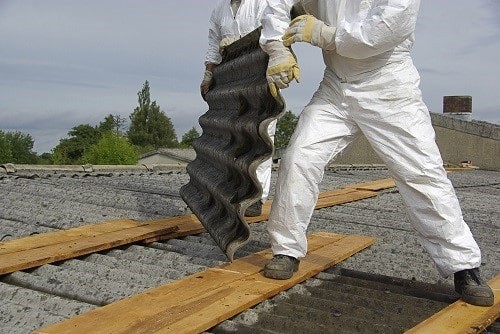 Many other nations, alive to the dangers of asbestos in situ, have adopted long-term asbestos eradication policies and plans. Photograph: iStock
Given the direct legal instruction upon HSE to research the risks of asbestos in-situ and from chrysotile (white asbestos) (as set out by section 11 of HSWA 1974), it is due to a clear failure by HSE that cases of mesothelioma have not rapidly declined since the mid-2010’s, more than 40 years after the 1974 Act. The assumption that declining deaths follow declining importation, by 40 years, is being challenged by rates of disease not falling as fast as expected.
In contrast to the UK’s HSE, the equivalent French body (ANSES: Agence Nationale de Sécurité Sanitaire de l’alimentation, de l’environnement et du travail), asked this difficult question in 2005 and, following research published in 2009, overhauled their approach to asbestos materials in-situ.
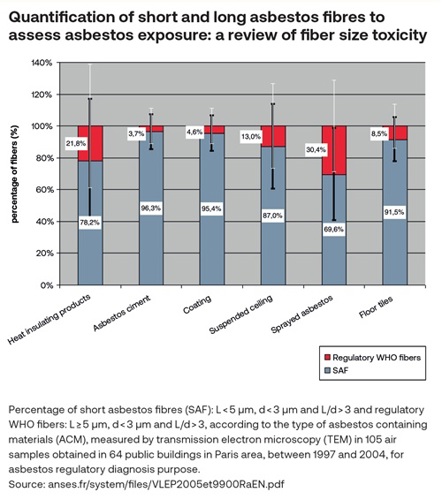
The first step was to embrace best practice in microscopy (laboratory techniques used to detect asbestos fibres in materials): namely TEM (transmission electron microscopy). With this technique (see graph below), they realised PCM (phase contrast microscopy), the standard British technique, was only detecting only 4.6 to 30.4 per cent of the total asbestos fibre count, when analysing asbestos-containing materials, such as roof sheets and pipework.
Alarmingly, the UK’s HSE continues to use testing methodologies for detecting asbestos in materials which cannot see most asbestos fibres and continues to ignore the risks from asbestos in situ.
HSE, by continuing to champion phase contrast microscopy, has failed to instill ‘best practice’ into guidance on how to use testing methodologies for detecting asbestos in materials and products, despite an explicit instruction upon them to do so, in line with the requirements of section 11 of HSWA 1974.
Many other nations, alive to the dangers of asbestos in situ, have adopted long-term asbestos eradication policies and plans. The UK, with the worst asbestos legacy in the world, continues to insist that asbestos in situ is safe.
But what of mesothelioma rates today? Due to the introduction in past years of regulations formally banning the importation and use of all forms of asbestos, rates are thankfully falling overall: policy intervention works! However, there is growing evidence of rising asbestos disease amongst cohorts who have not worked with asbestos, but have worked in buildings containing asbestos: essentially a ‘fourth wave’ of death from environmental exposure.
Writing in 2018, occupational hygienist Robin Howie stated that “teachers and nurses had about five and three times respectively more mesothelioma deaths than expected in populations not exposed to asbestos.’’
Meanwhile, in the same year a study with HSE collaboration concluded: “The average lifetime mesothelioma risk caused by recent environmental asbestos exposure in Britain will be about one in 10,000. The risk is an order of magnitude higher in a subgroup of exposed workers and probably in occupants in the most contaminated buildings.
“Further data are needed to discover whether asbestos still present in buildings, particularly schools, is a persistent or decreasing hazard to workers who disturb it and to the general population, and whether environmental exposure occurs predominantly in childhood or after beginning work.”
In 2024, Professor Taylor and colleagues from Mesothelioma UK highlighted that official mesothelioma statistics from the ONS (Office for National Statistics), which HSE uses to advise the Government, are severely understated. ONS data recorded 23 mesothelioma deaths amongst the teaching profession, whereas the number of teachers claiming mesothelioma related benefit payments is over three times higher, at approximately 70 per year.
More recently, in 2025, Professor Jukka Takala highlighted that cases of mesothelioma among women in Scotland doubled between 2001 and 2022, stating that, “the new unexpected exposures seem to hit nurses in hospitals, teachers in schools and many of the occupations that have never purposefully handled asbestos – from the exposure from older buildings and structures and closed or open environments where they are located”. It is notable that Public Health Scotland collects such data but it has not been collated for England and Wales, although similar trends may well be apparent in those countries.
UK mesothelioma data shows that the major first (mining and manufacture of asbestos) and second (installation of asbestos) waves of mesothelioma are declining, thus the overall numbers are falling. However, the data also shows the third wave (tradesmen working in buildings containing asbestos) and fourth wave (people living and working in buildings containing asbestos) are increasing, though the increases are smaller in magnitude compared to the major first and second waves.
These observations chime with the opinions of Professor John Cherrie, who compared the numbers exposed with the exposure level and duration, to tabulate ‘asbestos risk weightings’ for different groups. Professor Cherrie concluded that those working in buildings containing ACMs, such as teachers, have a risk factor of 45,000, while maintenance workers and firefighters have an estimated risk factor of 3,000.
He concluded: “The above analysis shows that most asbestos-related deaths from current and future exposure in Britain are likely to be amongst people working in buildings containing ACMs, but not actively disturbing the materials”.
It is important to highlight that the legal ‘duty to manage’ the risk of asbestos exposure is geared towards protecting maintenance workers (i.e. those working on the fabric of the building, or present while work is carried out on the fabric), but ignores the risk to those living and working in buildings containing asbestos. As a result of their vastly greater numbers, this group faces a 15-times greater overall risk of asbestos exposure (and therefore asbestos disease) than maintenance workers. Clearly the ‘Duty to Manage’ asbestos is built on flawed assumptions and will not protect those most at risk: society at large.
In 2023, the House of Commons Work and Pensions Select Committee issued a report following its inquiry into asbestos management. This recommended a 40-year plan to eradicate asbestos, prioritising high risk materials first, with the plan informed and guided by a new national asbestos database. The Committee concluded that the current approach of management in situ was inadequate.
Since 2022, when the inquiry considered evidence, more research has been published into the extent and nature of occupational and environmental exposure to asbestos.
The reasons offered by the-then UK Government for not enacting the Committee’s 2022 recommendations were cost, feasibility and efficacy. The Government argued that a national asbestos database was not feasible and would be prohibitively expensive, largely due to difficulties with information technology. These reasons have not aged well: technology moves fast!
Despite the latency periods of asbestos disease and the erosion of urgency this results in, the evidence is now clear and growing. The case against ‘management in-situ’ of asbestos has continued to crumble like a CLASP school built in 1963, lined with brown asbestos.
Asbestos is dangerous and society would thank the current Work and Pensions Minister, Sir Stephen Timms, who was chair of the Work and Pensions Select Committee when it issued its report in 2022, if he had the courage to enact his own recommendations without delay.
Charles Pickles is the founder of Airtight on Asbestos, a campaign that aims to improve the UK’s approach to the management of asbestos. For more information see:
airtightonasbestos.uk