
British Safety Council India held a conference designed to help organisations strengthen safety performance through practical, real-world approaches on 9 October at the Hyatt Regency in New Delhi. The conference, ‘Achieving Continual Improvement through Safety Excellence’, aimed to help attendees implement effective workplace safety and health policies and practices. The event focused on ways of achieving safety excellence through practical insights into health and safety risk management, India’s new Labour Codes, behaviour-based safety and effective worker training.
News
Leadership and compliance take centre stage at British Safety Council’s India 2026 conference
By
on 19 November 2026
Each session was presented by experienced and certified safety professionals with extensive experience across sectors such as construction, logistics and engineering. The speakers sought to ensure that discussions were grounded in practical realities rather than abstract theories. Participants gained insights drawn from real workplace challenges, regulatory audits and incident management scenarios.
A presentation by M Kamarajan, senior head of education at British Safety Council India, explained how India’s Labour Codes and the Jan Vishwas amendments, which decriminalise minor, technical and procedural offences in order to improve ease of living and doing business, are reshaping workplace safety compliance.
The four Labour Codes on wages, social security, industrial relations, and occupational safety, health and working conditions (OSHWC) replace 29 central labour laws.
Explaining how the decriminalisation of certain minor, technical and procedural offences will affect the implementation and enforcement of employers’ duties under the OSHWC Code, Kamarajan said:
“Decriminalisation under the OSHWC Code shifts many minor, technical and procedural lapses from criminal prosecution to corrective and civil enforcement, but it does not remove strong consequences for serious safety failures.”
Kamaraja added that serious breaches of the OSHWC Code will still result in imprisonment and substantial fines. In particular, there will be penalties of up to two years’ imprisonment and/or a ₨5 lakh fine for fatal accidents; up to one year’s imprisonment or a fine of ₨1–2 lakh for serious bodily injury; up to two years’ imprisonment or a ₨5 lakh fine for hazardous-process violations; up to three months’ imprisonment or a ₨1 lakh fine for obstructing an inspector; and up to three months’ imprisonment or a ₨1 lakh fine for falsifying records. General safety violations could attract penalties of ₨2–3 lakh under the OSHWC Code, he added.
Leadership presence matters
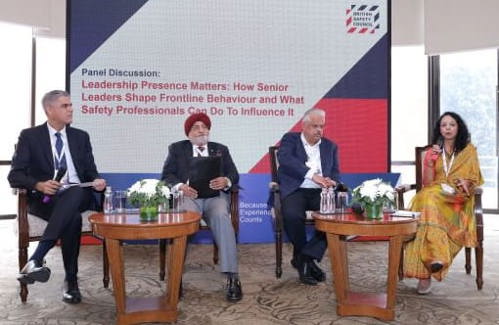
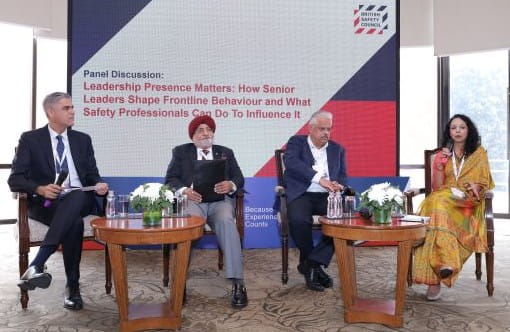
During the panel discussion, Leadership presence matters: How senior leaders shape frontline behaviour and what safety professionals can do to influence it, Hemant Sethi, managing director of British Safety Council India, opened the debate by reiterating that leadership influences safety culture through visible behaviour, communication, follow-through and decision-making. Employees ‘views on safety are formed in large part by observing what leaders prioritise and reinforce in their daily work, he said.
Retired Rear Admiral JS Mann, an expert in shipbuilding and marine technology at Boston Consulting Group, said: “People follow the leader; they do not follow instructions. They follow the behaviour of the leader, so ownership should come from the leader.”
He added: “In the services, we have a system called regimentalisation, where a leader is held responsible for any act committed by anyone serving under them. You cannot say, ‘I did not know that so-and-so had done this or that’. You have to put your hand up and say ‘mea culpa – I am responsible for any act committed by anyone under my command’. It is very important that leaders take responsibility and that their behaviour is policy-driven. There should be means provided to personnel, including subcontractors, to work safely and execute their duties.”
Rear Admiral Mann added: “As far as ownership at the highest level is concerned, let me tell you that we had three accidents in the Indian Navy despite having robust SOPs (standard operating practices). One submarine had an explosion, one ship caught fire and capsized, and another vessel tilted to one side when it was floated.
“All three accidents could have been avoided if proper technical competence had been applied to prevent them, although the fire and capsizing were attributed to human error. This brings us to leadership. The Chief of the Naval Staff at the time, Admiral DK Joshi, took ownership and resigned from the post. He was the first Indian Navy chief to resign from office.”
Ownership of safety
Speaking about his experience working at L&T Shipyard, Rear Admiral Mann said: “At L&T Shipyard, ownership of safety starts at the chairman’s level and filters down through the organisation. Every board meeting begins with a presentation on safety performance, covering the safety record, the number of accidents and even first-aid cases.”
Recounting an incident in which three people died at the worksite of a leading contracting company, P Ramakrishnan, director and chief executive (technical), at real estate company DLF Limited, said: “The chairperson [of the contracting company] said 2,400 people are working at the site and only three people died, so what is the problem? This attitude has to stop. Whether it is a large contracting company or a small contracting company, they must understand human life is precious.”
He added: “Compromise on anything but do not compromise on the safety of those working at the site.”
Disconnected leaders
Noting that senior leaders can often be distant from the workforce because of their responsibilities and the scope of their roles, Hemant Sethi, managing director of British Safety Council India, asked Madhvi Goyal, chief human resources officer and sustainability head at Bharti Real Estate, about the impact this disconnect can have on occupational safety and health.
Goyal said: “The more distant a leader is, the more harmful it is for the safety and wellbeing of people on the ground. Safety is not always as much of a strategic priority for leaders as market share or discussions about growth trajectories. The more distant leaders are, the more safety professionals feel undervalued. Other functions, such as marketing, can take the limelight, leaving safety professionals’ contributions overlooked.”
Experts on the panel agreed that when safety awareness becomes part of daily operations rather than an enforced rule, incident rates decline and accountability strengthens organically.
The session From compliance to confidence: Building fire and life safety excellence, led by Jeewan Mahadik, senior head of audit and consultancy at British Safety Council India, explored the importance of going beyond regulatory compliance to build a stronger fire and life-safety culture.
The conference featured several other engaging sessions, including a panel discussion entitled From dashboards to decisions, which explored how digital safety technologies are transforming organisational risk management in India. This was followed by a ‘fireside chat’, Safety excellence in action: From good practices to great outcomes, and a session on Behaviour-based safety: Driving culture transformation, led by Rajat Tewari, head of safety excellence at British Safety Council India.
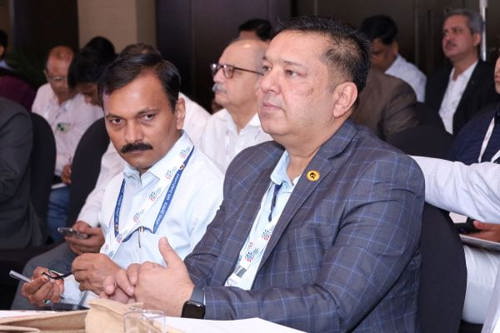
“Learning is most effective when it is engaging,” said a participant at the conference. “At each of the sessions, we were encouraged to ask questions, discuss operational challenges and share experiences from our industries. This interactive format transforms passive listeners into proactive safety contributors.”
NEWS
Leadership and compliance take centre stage at British Safety Council’s India 2026 conference
By Orchie Bandyopadhyay on 19 November 2026
British Safety Council India held a conference designed to help organisations strengthen safety performance through practical, real-world approaches on 9 October at the Hyatt Regency in New Delhi. The conference, ‘Achieving Continual Improvement through Safety Excellence’, aimed to help attendees implement effective workplace safety and health policies and practices. The event focused on ways of achieving safety excellence through practical insights into health and safety risk management, India’s new Labour Codes, behaviour-based safety and effective worker training.