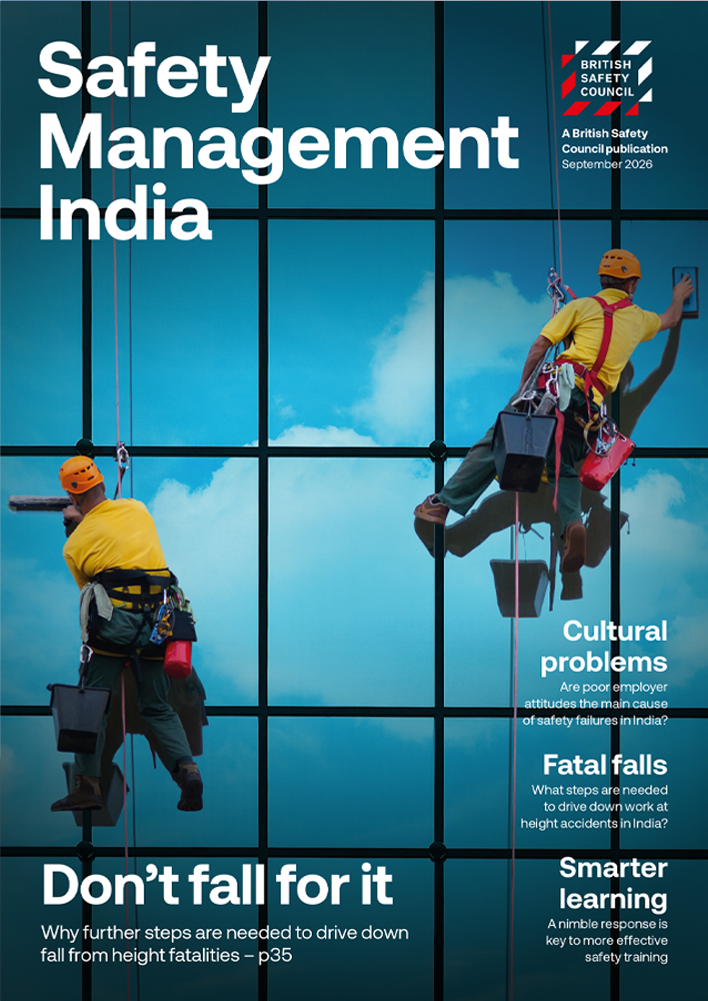
Safety training has often been delivered on a time-based cycle, such as annual courses and refreshers, but with new hazards and risks emerging at an ever-growing rate, it is essential that employers continuously monitor for changing risks, provide updated training, and check the new knowledge taught is actually making work safer.
Features
Learning velocity: the new measure of safety maturity
By
on 13 September 2026
There is a reassuring certainty in a completed training record. A course has been delivered, attendance is recorded, an assessment is passed and the learning management system turns green. But what has actually changed? Can the employee recognise the hazard in an unfamiliar situation? Will the supervisor make a different decision when production is under pressure? Has the organisation become better able to anticipate a risk that did not exist when the course was written?
These questions matter because work no longer changes at the pace of the annual training calendar. Artificial intelligence is altering roles and decisions within months. Climate change, automation, new materials, regulation, hybrid work and global supply chains are continually reshaping the conditions in which people work.
The World Economic Forum estimates that 39% of workers’ existing skill sets will be transformed or become outdated between 2025 and 2030. The International Labour Organization reports that more than 2.4 billion workers are exposed to excessive heat, while growing risks from floods, wildfires, storms and other extreme weather events are introducing new operational hazards, disrupting established controls and placing additional pressure on workers and managers. These are not abstract future risks. They are already changing risk assessments, emergency arrangements, safe systems of work and the skills people need to remain safe and healthy. Yet many organisations still review training and competence on fixed one-, two- or three-year cycles, as though the workplace remains unchanged.

The great assumption
For more than a century, occupational health and safety has been built upon an admirable belief that if people understand the hazards they face, they will make safer decisions. It is an assumption that feels so self-evident that we rarely stop to question it. Knowledge reduces ignorance, which leads to better choices, which in turn prevent harm. The logic appears almost irrefutable. Education has transformed workplace health and safety by helping workers recognise hazards, understand controls and carry out tasks more safely. Training has strengthened competence in areas such as machinery safety, work at height, hazardous substances, manual handling, fire safety, isolation procedures and emergency response. It has also helped supervisors and managers understand their responsibilities, assess risk more effectively and intervene before harm occurs. Without knowledge, there can be no competence. But knowledge alone does not guarantee that people will act safely when faced with time pressure, conflicting priorities, weak supervision or poorly designed work.
But somewhere between knowledge and behaviour lies a space that is far more complicated than many organisations would like to admit. Every safety professional has seen it. The employee who can recite the permit-to-work procedure but bypasses it when production falls behind. The experienced engineer who understands isolation better than anyone else on site but takes a shortcut because the task will “only take a second”. The driver who has completed fatigue training but continues a journey while exhausted. Consider some of the behaviours you might exhibit yourself as you reassess a risk and alter your behaviour.
These are not necessarily failures of knowledge. They are failures of translation, from knowledge to judgement, behaviour and sustained practice. People do not make decisions using information alone. They also respond to habit, time pressure, perceived norms, workload, incentives, confidence, fear, convenience and the behaviour of those around them. A beautifully designed training course cannot, by itself, overcome a system that rewards speed, tolerates workarounds or makes the safe action unnecessarily difficult. This does not make training ineffective. It means we must stop asking training to solve problems that sit beyond the classroom.
From training volume to learning velocity
Learning velocity is not the speed at which an organisation puts more people through courses. It is the speed at which it identifies changing risk, creates or sources knowledge, develops capability, supports application and evaluates whether work has improved.
That definition contains an important challenge. Faster is not automatically better. Poorly designed, untested or inaccurate learning delivered quickly may simply spread misunderstanding at scale. Learning velocity must combine speed with quality, relevance and assurance.
So, for example, when a new risk appears, how quickly is it recognised? How long does it take to update guidance, training and supervision? Can employees practise the response? Are managers equipped to reinforce it? Can the organisation see whether the change has reached the workplace?
The half-life of competence
Competence faces two forms of decay. The first is human forgetting; the second is the obsolescence of the knowledge itself. Research in cognitive psychology has repeatedly shown that information is more likely to endure when learning is spaced over time and people are required to retrieve and use it, rather than simply hear or reread it. A major review of distributed practice found strong evidence for the benefit of spacing, while experimental work by Roediger and Karpicke demonstrated that retrieval practice can improve longer-term retention. A single annual course may create short-term familiarity, particularly when followed by a simple knowledge test. But familiarity is not durable learning, and neither guarantees competent performance months later under pressure.
The second form of decay is newer and potentially more disruptive. Even when people remember what they were taught, what they were taught may no longer be sufficient. A manager trained to supervise an on-site office team may now need to recognise psychosocial risks across hybrid work. Maintenance teams may encounter battery systems, automated equipment or digital diagnostics that did not exist when their competence was assessed. Heat-stress arrangements designed for occasional hot days may no longer be adequate when prolonged spells of high temperatures arrive.
Competence therefore has a changing shelf life. It cannot be treated as a permanent asset acquired at the point of qualification. It must be maintained, tested and renewed. This does not weaken the case for formal training or recognised qualifications – it strengthens it. Strong foundational education gives people the principles, language and judgement needed to interpret new situations. But foundations must be connected to continuing learning, workplace practice and emerging evidence.
The certificate is not the end of learning. It is the point from which learning continues.

Beyond teaching
The most important learning often happens after the course has finished. A learner returns to work and soon has an opportunity to apply a new approach. A supervisor encourages the change or signals that the old way is quicker. Colleagues reinforce the learning or dismiss it. Procedures enable the expected behaviour or make it difficult.
Research on training transfer supports this wider view. A meta-analysis examining training sustainment found that peer, supervisor and organisational support all play a role in whether newly learned knowledge, skills and attitudes continue to be used at work. Broader evidence also shows that training can produce meaningful improvements in learning, behaviour and organisational results, but its effectiveness depends on design and evaluation rather than attendance alone.
Training should therefore be designed as an intervention in a working system, not as an isolated educational event.
Before learning begins, organisations need clarity about the problem they are trying to solve. Is the desired outcome better hazard recognition, stronger leadership decisions, improved investigation quality, greater confidence to intervene, or more consistent application of a procedure? The answer should influence the content, audience, delivery method, opportunities for practice and measures of success. During learning, people need realistic scenarios, discussion, practice, feedback and connections to their own experience. Afterwards, managers need to create opportunities for application. Follow-up activities, coaching, workplace observation, peer discussion and targeted refreshers can turn an event into a continuous learning process. This is what it means to embed learning beyond teaching.
What if we stopped measuring attendance?
Training inputs are attractive because they are visible and easy to count. We can measure how many people enrolled, how many hours were delivered, how many courses were completed and how many learners passed an assessment. These measures are useful – organisations need to know whether learning reached the intended audience and whether basic requirements were met. But an input is not an outcome.
A 100% completion rate does not tell us whether people can recognise a weak signal, challenge a poor decision or adapt when conditions change. A high satisfaction score may tell us that learners enjoyed a course, but not whether they will work differently in light of what they have been taught. Even a knowledge assessment demonstrates performance at a particular moment, under particular conditions.
The more valuable evaluation questions come later. What can people now do that they could not do before? What decisions are being made differently? Has the quality of risk assessment, supervision or incident investigation improved? Are employees more confident in raising concerns? Are expected behaviours visible in routine work? Has the organisation reduced variation, rework, exposure or the recurrence of known problems?
These questions are harder to answer because training is rarely the only influence on performance. That is not a reason to retreat to convenient measures; it is a reason to evaluate more intelligently. The goal is not to prove that a course caused every improvement; it is to build credible evidence that learning has contributed to the result the organisation needed.
Learning requires voice
An organisation cannot learn quickly if its people do not feel able to share what they know. Emerging risks are often first noticed at the frontline: a workaround becoming normal, a new material behaving unexpectedly, a workload pressure changing decisions, or a procedure no longer matching how work is actually performed. These signals may never reach a training team or senior leader if employees believe that speaking up will be ignored or punished.
Amy Edmondson’s research found an association between psychological safety (where people feel confident speaking up about problems and sharing ideas without fear of negative consequences), and learning behaviour in work teams. This matters because learning velocity depends on the movement of information, especially uncomfortable information, across organisational boundaries.
Training can support this by building skills in questioning, listening, reporting, investigation and constructive challenge. But leaders must create the conditions in which those skills can be used.
The fastest learning organisation is not the one that sends information downwards most efficiently; it is the one that can also hear weak signals travelling upwards and sideways.

A new measure of safety maturity
For years, organisations have measured training activity as evidence of safety maturity. Perhaps the next stage is to measure learning capacity. How quickly can the organisation identify a new competence need? How confidently can it update learning without compromising quality? How well does it connect formal training with supervision, practice and feedback? How effectively does it learn from everyday work, not only from incidents? How clearly can it demonstrate that learning has influenced decisions and performance?
These are questions about governance, culture and leadership as much as education. They reposition training from a compliance cost to a strategic capability. In a world of stable hazards, organisations could rely on established knowledge and periodic refreshers. In a world of accelerating technological, environmental and social change, they need something more dynamic: strong foundations, rapid updating, continuous reinforcement and meaningful evaluation.
Managers and safety professionals should therefore look beyond training completion rates and ask a harder question: how long does it take our organisation to move from recognising a new risk to changing what people actually do? If the answer is measured in years, annual refresher cycles or the date of the next scheduled course, the organisation may already be falling behind. Learning velocity means shortening that gap, by listening to the workforce, updating competence quickly, supporting people to apply what they have learned and checking whether the workplace is genuinely safer as a result.
The next time a training dashboard turns green, do not treat it as the end of the process. Go and look at the work. Ask what has changed, and ask what has not. Then decide what learning needs to happen next.
Five ways to increase your organisation’s learning velocity
1. Start with the work, not the course
Before commissioning training, define the problem you are trying to solve. What decision needs to improve? What behaviour needs to change? What risk needs to be better controlled? Do not begin by asking, “Which course should we deliver?” Begin with, “What needs to be different in the workplace?” Training may be part of the answer, but poor equipment, conflicting targets, weak supervision or badly designed processes cannot be corrected through learning alone.
2. Measure the time from signal to safer practice
Track how quickly your organisation responds when a new risk, working method or competence gap is identified. How long does it take to update guidance, brief managers, provide learning and confirm that the change has reached frontline work? The longer this takes, the greater the organisation’s learning lag. Do not wait for the next annual refresher if the risk has already changed.
3. Design the follow-through before the training begins
Decide how employees will apply, practise and discuss the learning when they return to work. Managers should know why someone is attending, what they are expected to do differently and how that change will be supported. A course without follow-through may improve knowledge temporarily. A course connected to coaching, workplace observation, feedback and management reinforcement is far more likely to improve performance.
4. Test judgement, not just memory
Passing a knowledge test does not necessarily demonstrate competence. Use realistic scenarios, practical exercises and workplace conversations to explore how people respond when information is incomplete, priorities conflict or a senior colleague encourages a shortcut. The aim should not simply be to produce employees who know the correct answer. It should be to develop people who can make defensible decisions when the answer is not obvious.
5. Leave the dashboard and look at the work
Completion rates provide useful assurance, but they are not proof that risk has been reduced. Speak to employees, observe tasks and review the quality of decisions being made. Ask what people are doing differently, what is preventing them from applying their learning and whether procedures still reflect operational reality. The strongest evidence of effective training will not be found in the learning management system. It will be visible in how work is planned, discussed and carried out.
The safest organisations of the future will be those that can learn, adapt and build competence as quickly as the world of work changes.
Dr Julie Riggs is education and membership director at British Safety Council. Contact and connect with her at:
britsafe.org
linkedin.com/in/dr-julie-riggs-dprof-cfiosh-27283820/