
Over half of UK workers believe a major industrial disaster is becoming increasingly likely, a major new report reveals today.
News
More than half of UK workers fear major industrial disaster as safety ‘perfect storm’ nears reality
By
on 10 June 2026
In Dräger’s Safety and Health at Work Report 2026, 53 per cent of workers surveyed said the risk of such an event in their sector is higher today than it was ten years ago.
Global volatility and uncertainty appear at least partly to blame, with almost three-quarters (72 per cent) saying that supply chain disruptions have made it harder to obtain parts, materials, or support, and a further 69 per cent reporting that global uncertainty has increased stress and fatigue, contributing to workplace errors or unsafe behaviours.
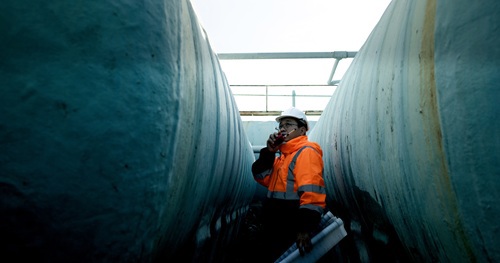 More than half of UK workers believe there’s a growing likelihood of a major industrial disaster. Photograph: iStock
Frequent organisational changes or strategy shifts, driven by external volatility, are also making safety harder to manage, according to 61 per cent of those taking part in the research. Global uncertainty is also increasing operational pressure, making it harder for people to focus on safety-critical tasks.
Concerningly, of the 1,000 workers surveyed, six in ten say leaders are out of touch with frontline safety risks.
Matthew Bedford, Draeger Safety UK's managing director, said: “Over the past six years, the landscape of workplace health and safety has continued to shift, shaped by the immediate disruption of the pandemic, ongoing financial pressures, global instability, and changing workforce expectations as new generations enter employment.
“The findings of the 2026 report reflect a wider environment of ongoing global uncertainty and volatility, and concerningly, suggest that the ‘perfect storm’ of factors affecting workplace safety and health, as highlighted in last year’s report, may be closer to becoming reality than is comfortable.”
The report also tracks a weakening of trust in support systems and leadership, with the majority placing greater trust in their own actions than in leadership, institutions or technology.
While many organisations now encourage open communication and ‘speaking up’ when it comes to safety, employees do not always feel confident doing so in practice. Indeed, half of UK workers are too afraid to speak up on safety in the current climate.
The report says all this point to “room for improvement when it comes to workplace safety culture.”
Ian Cooke, director of audit, consultancy and culture change, quoted in the report, said trust is “fundamental to creating workplaces where people can stay safe, healthy and well.” “The findings suggest a weakening of the shared, collective trust needed for strong safety culture and in these conditions, trust becomes both more fragile and more important,” he said.
“Strong leadership, open communication, visible action and shared accountability are what builds trust across organisations. When trust is present, people are more likely to highlight risks, collaborate effectively and look after one another - all of which are essential to safer, healthier and more resilient workplaces,” he added.
Read Dräger’s Safety and Health at Work Report 2026 here
NEWS

Remembering British Safety Council India colleague, Anindita Sengupta
By British Safety Council India on 17 September 2026
It was with great sadness that the staff of British Safety Council India learnt of the passing of their much-loved and respected colleague Anindita Sengupta, following a long and courageous health battle.

Government hails progress in rolling out social security for unorganised workers as e-Shram portal reaches 318.9 million registrations in five years
By Orchie Bandyopadhyay on 17 September 2026
Five years after its much-heralded launch, the Indian Government has announced that its e-Shram digital portal designed to enable unorganised workers to access eligible social security benefits has hit the milestone of 318.9 million individual registrations nationwide.
British Safety Council calls on UK Government to ban silica-containing materials
By on 20 August 2026