Here in the UK, we are already living with the consequences of climate change. We’ve recently had repeated heatwaves, which followed heavy rainfall and flooding across many parts of the country earlier this year. Climate change is shaping the conditions in which we live and work today. Climate change is most definitely a workplace-safety issue.
Opinion
The climate has changed – now workplace safety must adapt
By
on 28 July 2026
The impacts are being felt across the economy. Employers face growing operational risks, increased workforce vulnerability, and a greater likelihood of disruption to supply chains, transport networks, and critical services. What were once considered exceptional weather events are becoming more frequent, more intense, and more disruptive.
The Climate Change Committee’s recent report, A Well-Adapted UK, sets out the practical steps needed to prepare for this changing climate. It offers a blueprint of solutions to build a safer, healthier, and more resilient UK.
 Sophie Vipond: "As workplace risks evolve, safety professionals are uniquely positioned to help organisations respond."
For businesses, the report highlights a challenge that many safety professionals will already recognise – that the baseline level of risk is changing.
The Committee’s analysis identifies three major climate risks facing the UK: heat, flooding, and drought. We expect all three to intensify over the coming decades. By 2050, up to 92 per cent of homes could face overheating, peak river flows could increase by as much as 45 per cent, and water supply shortfalls could exceed five billion litres per day. These are not just environmental risks; they are workplace risks.
Three key priorities
Safety professionals should be thinking about three key priorities. These are safeguarding workers exposed to heat stress, supporting outdoor and frontline employees during extreme weather events, and ensuring buildings and infrastructure are resilient to both flooding and overheating.
Some sectors face particularly acute challenges. Construction, agriculture, logistics, and emergency services often operate at the sharp end of climate impacts, with workers regularly exposed to high temperatures and severe weather. However, no sector is immune. Offices, warehouses, manufacturing facilities, healthcare settings and public services all need to consider how climate change could affect their people, operations and assets.
Heat is perhaps the most immediate concern. Evidence shows that 70 per cent of the global workforce - 2.4 billion workers - are exposed to excessive heat each year. Higher temperatures increase the risk of dehydration, heat stress, fatigue, and reduced concentration. Workers carrying out physically demanding tasks outdoors or in poorly ventilated buildings are particularly vulnerable. There are risks to productivity and health in these settings.
Flooding brings a different set of challenges. It can damage premises, disrupt transport routes (preventing staff from reaching work), and create hazardous conditions for employees.
Drought and water scarcity may be less visible as workplace risks, but they place pressure on industrial processes, affect productivity, and threaten business continuity.
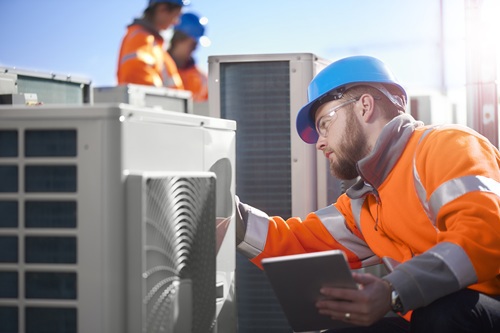 One of the report's recommendations is to fit air conditioning units into all critical settings by 2035. Photograph: iStock
Employers cannot simply respond to individual extreme weather events as they occur. They must recognise that climate risks are becoming a permanent feature of the operating environment and prepare accordingly.
Resilient building design
The good news is that solutions exist. At the Climate Change Committee, we have called for action to update standards and policies to reflect the changing climate and for investment in resilient building design and cooling measures.
Other measures include improving preparedness for extreme weather events and strengthening communication with employees during periods of heightened risk.
You could say this is not a new way of thinking. Effective risk assessment has always been the foundation of good health and safety management, and now climate adaptation should be seen as an extension of that.
Our report recommends rolling out cooling (whether ‘passive’ measures such as shading or blinds, or ‘active’ measures such as air conditioning) in all critical settings including hospitals and care homes by 2035, and schools by 2050.
We also want to see national maximum workplace temperature regulations brought in to protect workers’ safety and incentivise the deployment of cooling.
Importantly, adaptation should not be categorised only as an additional cost. A workplace that remains safe and productive during a heatwave, operational during flooding and resilient during periods of water stress is better able to protect its people and its performance.
Cost of failing to adapt
The economic case is compelling. We estimate that delivering the adaptation measures needed across the UK would cost around £11 billion per year (this is split about 50/50 between public and private costs). By contrast, failing to adapt could see climate-related damages rise to between £60 billion and £260 billion annually by 2050, under a 2°C warming scenario.
Of course, adaptation alone is not enough. The UK must continue to reduce emissions rapidly to limit future warming. That is the only thing that will reduce the scale of future climate change.
As workplace risks evolve, safety professionals are uniquely positioned to help organisations respond. By embedding climate resilience into risk management today, employers can better protect their workforce, strengthen business continuity and help ensure that UK workplaces remain safe, healthy and productive in the decades ahead.
Read the full report, A Well-Adapted UK. The Fourth Independent Assessment of UK Climate Risk, at:
theccc.org.uk/publication/a-well-adapted-uk/
Sophie Vipond is director of external affairs at Climate Change Committee