
Businesses are increasingly striving to make workplaces and job roles fully inclusive for disabled workers, but in a time of great change it’s vital to remember the importance of reasonable adjustments at work as AI becomes more important in our workplaces.
Features
Equality and inclusion at work: why we must keep pushing forward on disability inclusion
By
on 05 May 2026
Employers and businesses are facing challenging times. The geopolitical climate, economic pressures, and navigating the opportunities and also the unknowns that AI presents are just some of the issues facing organisations.
For those working in HR or health and safety roles, it may be difficult to know how you can provide the best outcomes for colleagues with disabilities and long-term conditions when change is happening at pace and so much may seem outside of your sphere of influence and control.
At these times, it is important to remind yourself why the work you do is important and the difference it has made and is still making.
Business Disability Forum’s annual Disability Smart Impact Awards took place on 29 April. These awards are an opportunity for BDF to showcase and share the work of professionals who are continuing to make a positive difference to lives of disabled people – day in, day out. Despite the ever-changing landscape, this year’s awards were no exception. You can read some of the stories in the ‘Disability Smart Impact Awards 2026: Winners’ section of this article.
 Inclusive recruitment practices remain vital if employers are to continue to attract the talent needed and avoid a future skills shortage. Photograph: iStock
There are three encouraging lessons that we can all take from these stories.
Firstly, good work around disability inclusion is still happening, at both a local and global scale, even if negative news stories may try to suggest otherwise.
Secondly, the provision of timely, person-centred workplace adjustments remains central to improving workplace experience for disabled people and productivity more widely. I will return to this topic later.
Thirdly, disabled people and the experiences they bring remain an asset that can help to improve the workplace for everyone – not just people who identify as disabled. Disability inclusive approaches benefit everyone.
The challenges are real
So, there is much to be positive about, but that does not mean the challenges facing employers and disabled people right now are not real.
A poll of 1,073 disabled adults in the UK published by BDF in December found that 43 per cent of respondents thought it was harder for them to look for jobs and attend interviews than people without disabilities.
At the same time, the latest figures from the Office for National Statistics (ONS) show that approximately one in eight young people in the UK (aged 16–24) are not in education, employment or training (NEET). This is the highest figure since 2020. Data also shows that over a quarter of young people in this group say that long-term sickness or disability is a barrier to them getting into work.
This means that inclusive recruitment practices remain vital if employers are to continue to attract the talent needed and avoid a future skills shortage.
In practice, this means taking an end-to-end look at your recruitment processes and identifying anything that may be acting as a barrier for disabled candidates. Think about:
- Are you advertising in the right places?
- Is there any language in the job ad or job description which may put disabled people off applying?
- Are the online portals that you are using accessible to disabled people? Do they work with assistive tech, such as screen readers?
- Do those involved in the recruitment process have a good understanding of disability, the adjustments that people may need and the adjustments that your organisation may be able to offer? In our poll, 40 per cent of disabled respondents, either in work or looking for work, said that they felt a better understanding of disability would improve their workplace experience.
The ongoing importance of workplace adjustments
But, as we all know, disability-inclusive practice does not begin and end with recruitment. The provision of needed adjustments remains core throughout the employee lifecycle. This is reflected in the fact that workplace adjustments remain one of the top issues that our advice service is asked about. BDF has created a set of free condition-specific factsheets to provide employers and HR teams with information on commonly requested adjustments.
While we know that workplace adjustments are important, we also know that many disabled people are continuing to wait too long to get the adjustments they need. This can be a matter of internal processes not being joined up, a lack of awareness of adjustments generally, internal budgetary issues or a lack of confidence in line managers to have a conversation about adjustments and to ask people what they need.
There are also external issues, such as the ongoing delays around the Government’s Access to Work scheme. With the scheme overwhelmed and under resourced, we know that some people are waiting nine months or even longer for their application to be processed. At the same time, some disabled employees are seeing their awards reduced when it comes to renewing their applications.
How can employers respond to all these challenges? This is a question that we are often asked, especially when finances are tight and increasing internal budgets may not be possible.
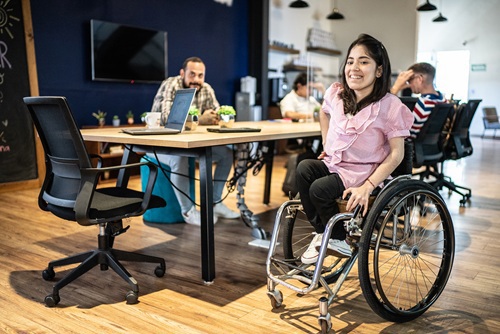 Many disabled people wait too long to get the adjustments they need. Photograph: iStock
We would suggest the following:
- Ensure you have a robust and responsive workplace adjustments process with a single-point of entry and it is centrally funded. This will speed up the processing of applications.
- Publicise the process and make sure managers know how to use it. Line managers play a vital role in supporting disabled employees to access the adjustments they need. Make sure they are confident using the process and know the types of adjustments that are available.
- Have a clear sign-off process and consider giving line managers the authority to sign off lower-cost, regularly requested adjustments. Some companies now operate a trust-based approach where individuals can self-serve lower-cost adjustments (like assistive technology) without having to go through a process to request it.
- Equip line managers to have the conversation around ‘soft’ adjustments. Many adjustments are low cost or free, but they require a line manager to have a creative conversation with an employee to problem solve and co-create solutions. In our Great Big Workplace Adjustments Survey 2023, the most frequently requested adjustments were working flexibly or with adjusted hours and time off to attend appointments related to their disability or condition.
- Make sure HR, health and safety and occupational health leads understand the tests of “reasonableness” under the Equality Act and support managers to work through the process. The tests are whether the adjustment removes or reduces the barrier, someone is experiencing, whether it is practical, the cost, the disruption (including the impact on others) and whether there are any health and safety issues. If a requested adjustment is not “reasonable” then is there something else that would remove the barrier?
- Consider lower cost alternative adjustments if funding the requested adjustments is not possible. Remember that under the Equality Act the duty to make reasonable adjustments is with the employer and the Access to Work delays do not change this. Access to Work is only intended to cover the cost of adjustments that cannot be reasonably funded by employers. Delays in processing Access to Work applications, mean that some employers are covering these additional costs in the short term. If this is the case, be clear with employees how long those costs will be covered for.
- Communicate clearly with employees about expected processing times, including the latest waiting times for Access to Work (if Access to Work is being used), so you can manage expectations. Keep employees in the loop around delays. Remember that this can be a stressful time for employees, so keep them as informed as possible.
- Support individuals to start new applications to Access to Work as soon as possible to help minimise delays. Ask about adjustments as soon as the job offer has been made and if Access to Work funding is needed, encourage the individual to start the process then to reduce waiting time and to ensure adjustments are in place before a new hire starts.
- Support employees to reapply early. Employees need to reapply once the initial funding period (usually three years) ends or if their needs change. Waiting times for renewals can also be long, so help employees to start the process early.
The impact of AI
With AI having such an impact on the workplace, including around adjustments, it would be difficult to discuss workplace disability inclusion without discussing AI.
In April, BDF published a poll of disabled people’s views on AI accessibility. The poll of 1,032 people found that many disabled people were positive about the benefits that AI could bring with 38 per cent saying that they thought AI would improve communications and 34 per cent thought it would improve online experiences.
At the same time, however, only 22 per cent thought that AI tools would help improve access to work or workplace experience. The poll also found that one in five disabled UK adults (20 per cent) did not think AI products could help disabled people or did not know if they would (18 per cent).
The poll also asked respondents how AI tools could be made more accessible for disabled people. Designing, developing and user-testing products with disabled people was the top answer given by 40 per cent of respondents. Creating more user-friendly interfaces (38 per cent), greater availability of information about how AI can support disabled people (37 per cent), and more support to help disabled people get started with AI (36 per cent) were also highlighted.
For those working to make workplaces more inclusive, there is a lot we can take from these findings. AI may have the potential to change our workplaces for the better, but we need to make sure that our greatest asset – our people – are not left behind or overlooked as AI develops at pace.
Disabled colleagues need to be involved in decision-making around AI, from defining AI need through to procurement, user-testing and reviewing. When it comes to workplace adjustments, many disabled people rely on assistive tech to help them carry out their roles. It is important that any AI tools introduced work with and are compatible with this tech. AI may replace the need for some assistive tech but do not assume that it is an automatic replacement for all assistive tech. Individual needs and preferences must be considered.
At the same time, accessible training and learning opportunities around AI need to be made available to staff so that no one misses out.
We have created a free resource to help employers and HR teams think about these issues.
Change as a constant
When change is a constant, it can be difficult to know how best to advise and support colleagues on what is going to happen next and how it will affect them. While none of us possess a disability inclusion crystal ball, we can all make sure that we keep colleagues as informed as possible and involved in the decisions that will affect them.
Disability inclusive practices become even more important at times of change, so now is not a time to put disability inclusion in the ‘too difficult’ box. For more guidance on disability inclusion, go to:
businessdisabilityforum.org.uk
Disability Smart Impact Awards 2026: Winners
Inclusive recruitment winner: BBC
Extend is an evidence-led initiative that is re-engineering recruitment to create sustainable employment opportunities for deaf, disabled and neurodivergent talent. Moving beyond short-term schemes, it establishes ring-fenced permanent and fixed-term roles, inclusive recruitment practices and structured business support.
As part of the organisation’s ‘You Belong’ strategy, Extend has become a key driver of measurable diversity, contributing to a 12.2% representation of disabled and neurodiverse colleagues across the workforce,
while transforming how talent enters and progresses within a large and complex employer.
Workplace experience winner: Sutherland
US-based digital engineering company Sutherland’s Workplace Experience system functions across multiple countries and business lines, with consistency as its foundation. Employees are set up for success as soon as they enter the environment that anticipates their needs, tools offered are already compatible with assistive technologies, and a community of colleagues and leaders is provided who understand the principles of disability inclusive culture.
Built environment award winner: Lilly
Through its Access Lilly programme, global medicine company, Lilly, has transformed 50 of its worldwide sites with more than 10,000 accessibility improvements, making it easier for all its employees to thrive. The programme is based on a continuous ‘assess–improve–assess’ cycle that places user experience at the centre of decision-making. This approach ensures accessibility improvements are driven by real lived experience and best practice. The scale of improvements delivered is significant, including 78 retrofitted elevators, 2,400 upgraded signs with improved contrast and braille, improved ramps, adapted reception desks with induction loops, and hundreds of accessible toilet upgrades.
Diane Lightfoot recently featured in an episode of British Safety Council’s podcast, Health and Safety Uncut. Listen to Why it is vital to build a genuinely inclusive workforce at:
tinyurl.com/3nn2btes
Diane Lightfoot is CEO of the Business Disability Forum

FEATURES

AI at work: why employee monitoring may be creating new pressures
By Orchie Bandyopadhyay on 21 October 2026
India’s information technology companies are rapidly expanding their use of AI in a bid to drive business efficiency and boost innovation. However, commentators warn that the growing use of AI to monitor employees’ work outputs and activities poses a risk to workforce mental health and wellbeing.

Remote and hybrid working: how can employers best provide support?
By Orchie Bandyopadhyay on 21 October 2026
India continues to embrace remote and hybrid working, with large numbers of staff either working from home full time or following a mix of remote and office attendance. However, remote working can create feelings of isolation and loneliness, in turn affecting performance and mental wellbeing, so it’s essential employers have excellent communication and support procedures in place to prevent these problems arising.