
Trade unions have formally demanded that India’s new Labour codes be amended to require app-based platforms to take specific actions to protect gig and app workers from exposure to extreme heat, after India again began experiencing punishing high temperatures that began in April.
News
Gig worker unions demand new laws to protect India’s outdoor workers from heat-related health impacts
By
on 11 June 2026
A number of unions, including the Amazon India Workers Association (AIWA), Indian Federation of App-Based Transport Workers (IFAT) and National Hawkers Federation, recently wrote to the Union Government warning that while the new Labour Codes extend social security and minimum wage protection to workers in the informal sector, such as gig and platform workers, they do not include any provisions requiring employers to take proactive action to protect outdoor workers from extreme heat.
In 2025, the National Disaster Management Authority (NMDA) issued an ‘advisory note’ for app-based platforms and businesses that employ gig workers, such as online delivery platforms, strongly urging them to take a number of measures to protect the health, safety and wellbeing of gig workers during extremely high temperatures. The note came after India experienced prolonged heatwave conditions in 2024, and followed reports that platform workers had allegedly been docked wages for taking breaks during the hottest times of the day.
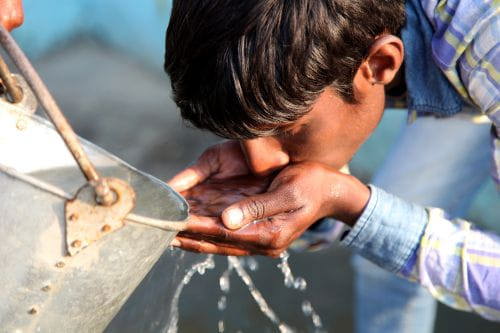
The advisory recommended platforms suspend outdoor work between 11am and 4pm during orange and red weather alerts from the India Meteorological Department, such as heatwaves, make heat-specific breaks mandatory, and provide safety kits to workers in the shape of UV protective shirts. Although the platforms failed to suspend work during the hottest hours of the day, some introduced ‘rest centres’, or resting points, for delivery workers, issued ‘cooling vests’ and provided improved health insurance coverage.
Enforceable minimum standards
However, several labour unions say the voluntary nature of the NMDA advisory is inadequate, and are now calling on the Union Government to amend the new Labour Codes to incorporate enforceable minimum standards to protect gig workers from extreme heat, which apply consistently across all app platforms and geographical locations during extreme heat events as classified by the IMO.
“Advisories don’t scare anybody, so no one is compelled to comply with them,” Nirmal Gorana, national coordinator of the Gig & Platform Service Workers Union, told the Mongabay news platform.
Amrita Tonk, partner at law firm CMS INDUSLAW, told Business Standard that while the NMDA advisory recognises that gig workers are exposed to heat health risks, there are major gaps in India’s legal framework in relation to ensuring occupational safety protections for workers exposed to high temperatures.
In a formal submission to the Union Government in April 2026, the Indian Federation of App-Based Transport Workers (IFAT) said the new Social Security Code should be amended to provide safety and financial protections for gig workers during high temperatures, Mongabay reported. In particular, the IFAT called for a legal right for platform workers to have paid ‘cooling breaks’ of at least 20 minutes for every two hours of recorded work on heatwave-days as classified by IMO and a new duty on aggregators to maintain a drinking water access plan for gig workers that is regularly audited by the relevant authorities.
According to Mongabay, the IFAT also called for platform workers to be compensated for time off during heatwaves, via government-run social security schemes that are funded by a levy on app platforms. It also demanded that measures are introduced to prevent aggregators docking wages or levying penalties if platform workers take time-off for heat-related reasons.
Stark divide
The widespread calls for better protection for outdoor workers from high temperatures come as the country is grappling with a brutal heatwave, with temperatures exceeding 45 degrees Celsius. Commentators say there is now a stark divide between the air-conditioned comfort enjoyed by office workers employed by India’s wealthier companies and the dangerous reality faced by low-paid outdoor workers, such as delivery drivers and street vendors.
According to the Ministry of Finance, there were 12 million gig and platform workers in India in the financial year 2025, and the government’s policy think tank NITI Aayog projects that number could rise to 23.5 million by 2029–30. With rising temperatures, India’s app-based delivery sector is facing tough questions on worker safety, platform accountability and customer expectations.
During the monsoon season, quick-commerce platforms warn customers about delays and, in some cases, introduce rain surcharges or incentives for workers operating in rough weather. However, during summer, there are no ‘heat delay’ warnings for customers.
The ongoing heatwave conditions also recently prompted Prime Minister Narendra Modi to urge all citizens to take precautions against the potential ill-health effects of exposure to high temperatures.
During his monthly radio programme, Mann Ki Baat, Modi said: “It is very hot in most parts of the country right now. Strong sun, hot winds – it is very important to take care of yourself in such weather.” The PM specifically advised people to stay hydrated and follow government-issued guidelines.
According to the World Health Organization (WHO), heat stress is a leading cause of weather-related deaths and can exacerbate underlying illnesses, including cardiovascular disease, diabetes, mental health conditions and asthma. It can also increase the risk of accidents and the transmission of some infectious diseases. Heatstroke is a medical emergency with a high case-fatality rate, warns the WHO.
“The number of people exposed to extreme heat is growing exponentially due to climate change in all world regions,” the WHO added.
The International Labour Organization states that while many countries have provisions in national legislation that could potentially be implemented and enforced to protect workers from excessive heat, in most cases, they are general in nature and do not adequately address the intensifying climate change-related dangers many workers face daily.
Punishing summer
Meanwhile, in a recent statement, Simon Stiell, executive secretary of the United Nations Framework Convention on Climate Change (UNFCCC), warned the ongoing “punishing summer” of extreme heat being experienced by large swathes of India is largely being driven by worsening climate change and the continued “massive” burning of fossil fuels, like coal, oil, and gas.
Stiell said the heat was inflicting “severe human and economic impacts”, particularly on people without access to cooling and those working long hours outdoors.
“The main culprit is worsening climate change, largely driven by the world burning colossal amounts of coal, oil and gas,” he stated.
Stiell added that soaring electricity demand in India during the heatwave, driven by ever-growing demand to power air conditioning, illustrated the “mounting strain extreme heat places on economies and public infrastructure”.
However, he said that India’s recent rapid expansion of solar power was already yielding benefits, with solar and other renewable energy sources helping to meet daytime peaks in electricity use.
“The heat extremes over India are a reminder of the potential of homegrown clean energy and energy efficiency measures,” Stiell added, arguing that cleaner energy could help deliver affordable electricity, cooling and greater energy security.
He added that heat extremes were likely to intensify further in India and elsewhere as the climate crisis deepens, making it vital to accelerate the shift towards renewable energy.
Referring to all countries, he stated: “More homegrown clean energy and energy efficiency measures could help provide cooling to the most vulnerable, and more secure and affordable electricity to help power homes, businesses, vital health services and electric transport.
“The current extreme heat also reinforces the need to invest more in building resilience to climate impacts, whether extreme heat, mega-floods, wildfires or droughts which are also hitting food production and prices.”
Meanwhile, Ahmed, a delivery worker in Dehi, said: “The environmental impact of climate change, shifting weather patterns, or vanishing biodiversity is widely known, but one must understand that Delhi is a very hot region in the summer, and gig workers work under stressful conditions, compounded by poor housing.
“We live in shacks or shanties with little ventilation, meaning we endure dangerously high temperatures day and night.”
He added: “People need access to drinking water and better housing. We need to raise awareness among employers, governments and consumers about how delivery workers live and how conditions need to improve.”

NEWS

Indian government developing social security scheme for gig and platform workers, says labour secretary
By Orchie Bandyopadhyay on 21 October 2026
In a bid to expand the country’s social security safety net, the Modi government is working on a proposed social security scheme for gig and platform workers, Ministry of Labour and Employment secretary Chandra Bhushan Kumar revealed in a speech to the Confederation of Indian Industry (CII) in September.