
A recent high-profile incident where hospital doctors were allegedly assaulted by a well-known politician in Maharashtra has prompted renewed calls for tougher sentences for those who attack healthcare workers, but some hospitals are already taking steps to defuse aggressive behaviour by patients and their families by rolling out communication skills training for medical teams
Features
Why Indian doctors are demanding zero tolerance for hospital violence
By
on 14 August 2026
Attacks on healthcare workers are common in India, prompting frequent protests by doctors and nurses at major public hospitals across the country, demanding greater protection from assault and harassment, usually committed by patients and their families.
The latest high-profile incident took place on 6 July at Shastrinagar Hospital in Dombivli, Thane, Maharashtra, where two doctors, including a woman, and other staff members were allegedly assaulted by a well-known local politician, three of his aides and a fourth unnamed individual. It is alleged that Ramesh Mhatre, a corporator (elected local municipal councillor), who is member of the Shiv Sena political party, and four others assaulted the medical staff following an argument over a patient’s treatment.
According to a report by NDTV media channel, hospital officials said the attack occurred after doctors Srushti Baviskar and Vaibhav Salunkhe advised the relatives of a newborn baby that, while the infant required specialist care, the hospital’s neonatal intensive care unit was at full capacity. As a result, they recommended the family transfer the baby to another medical facility.
The relatives then allegedly contacted Mhatre, who attended the hospital with his associates. The doctors allege that Mhatre initially verbally abused them and then assaulted them, with one of the doctors dropping their mobile phone as a result. Two nurses, Namita Ubale and Dravya Giri, who intervened in an attempt to protect the doctors, were also allegedly assaulted. Video footage subsequently shared on social media showed the alleged assault on the two doctors.
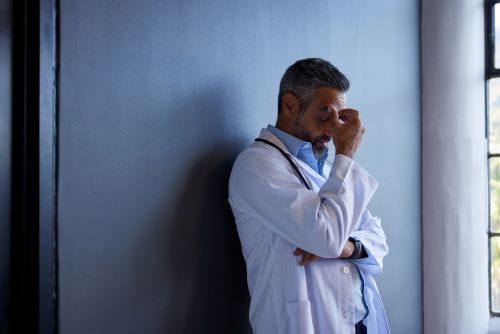
NDTV reported that, following the incident, the two doctors had resigned and left the city, saying they feared for their personal safety fears due to possible intimidation by persons unknown.
Speaking to NDTV, Mhatre denied assaulting the female doctor. “I did not attack the woman doctor at the hospital,” he claimed. “I only hit the doctor’s hand to get her off the phone as she was not listening to our complaint. Our action saved the lives of a woman and her child.”
Mhatre was arrested on 8 July and granted bail by a sessions court shortly afterwards. However, on 18 July, the Bombay High Court subsequently cancelled his bail and ordered him to surrender to police. He did so on 19 July and was remanded into judicial custody.
Subsequently, on 7 August, the Bombay High Court granted him bail, and he was released from custody, on the condition he stay away from Maharashtra until any formal court proceedings begin and does not contact any witnesses in the case. The High Court also bailed the other accused individuals, and imposed similar bail conditions on them, including surrounding their passports to police.
Medical staff organise public protest
Outraged by the incident and the initial release of the five accused individuals, the medical community organised protests, starting with a protest outside the hospital. The doctors and nurses also demanded that Mhatre be disqualified from his position as a corporator.
The Indian Express reported that the fallout from the incident escalated into a major confrontation between Maharashtra’s medical profession and the state government. The Maharashtra State Association of Resident Doctors and the Maharashtra State Nurses Association announced state-wide protests, demanding stricter action and long-term preventive measures to protect medical staff with violence and aggression from patients, their families and others such as trespassers and thieves at medical establishments.
The Maharashtra Senior Resident Doctors’ Association and Brihanmumbai Municipal Corporation Maharashtra Association of Resident Doctors also condemned the incident, and called on the state’s chief minister Devendra Fadnavis to directly intervene to ensure zero-tolerance to violence in the state’s public hospitals.
The Indian Medical Association’s (IMA’s) Maharashtra State branch also announced plans for a 24-hour state-wide strike, running from 06.00 am on 20 July to 06.00 am on 21 July, but this was called off after Bombay High Court cancelled Mhatre’s bail and he entered judicial custody.
Indian Medical Association demands action
IMA Maharashtra subsequently demanded that Maharashtra’s Government take immediate steps to protect healthcare workers in state-run hospitals and other government-run medical establishments from violence and aggression.
In particular, it called for the provisions of the Maharashtra Medicare Service Persons and Medicare Service Institutions (Prevention of Violence and Damage to Property) Act, 2010 to be strengthened to ensure both stronger sentences for those who assault medical staff and to ensure individuals charged with serious assaults cannot be granted bail by the courts. The IMA also called on the Maharashtra Government to increase the level of funding for state-run hospitals to improve the hospital infrastructure and facilities to help reduce patient anger arising from inadequate medical facilities, and to mandate that all government and private hospitals provide a 24/7 security presence and security arrangements to help reduce threats to medical staff.
The IMA further called on the Union Government to introduce a comprehensive, central and nationwide law aimed both at preventing violence to healthcare workers and introducing stricter penalties for those who assault hospital staff, to replace the various state laws, which set out a variety of offences and penalties for offenders.
Also, the IMA called on the Maharashtra Government to immediately enforce a strict, state-wide ‘Zero Tolerance Against Healthcare Violence’ policy, and to ensure there is no political interference in the criminal investigation and potential prosecution of Mhatre and the four co-accused assailants in relation to the alleged assault at Shastrinagar Hospital.
75% of doctors report encountering violence or aggression
According to the IMA, up to 75% of doctors in India have directly experienced or encountered some form of workplace violence. Consequently, the national leadership of the IMA has repeatedly called on the Union
Government to introduce nationally-applicable central legislation that gives the courts powers to impose significant fines and potentially long prison sentences for those who attack medical staff. The IMA has also called on State Governments to introduce hospital security protocols to control public access to medical establishments and medical treatment areas, similar to airport security arrangements, and to improve the working conditions of resident doctors in state-run hospitals.
A 2023 review published in the journal Cureus found that nearly three-quarters of surveyed Indian doctors had experienced workplace violence during their careers, with emergency departments, intensive care units and post-operative wards identified as the most vulnerable settings. Furthermore, a study in the Indian Journal of Occupational and Environmental Medicine revealed that 60.9% of 658 surveyed doctors experienced workplace abuse over the preceding year, while 3.9% reported physical assault, with night shifts and emergency care departments presenting the highest risk.
On a global scale, a recent survey revealed that 73% of critical care workers experienced violence over the past year, prompting a quarter of them to consider leaving the profession altogether.
Violence ‘never justified’
Commenting on the crisis, The Doctors Collective, an online platform that highlights the personal and professional lives of healthcare professionals globally through research and long-form storytelling, emphasised that hospitals must remain places of healing rather than fear.
“Patients and families have every right to ask questions, seek explanations, or file complaints,” it stated. “But assaulting doctors, nurses, or hospital staff can never be justified. Healthcare professionals work under immense pressure and deserve an environment where their safety and dignity are protected. Violence against healthcare workers cannot become a normal part of the job.”
Echoing this sentiment, Dr Dhruv Tewari, a physician at a private hospital in Delhi, remarked: “As doctors, we are here to save lives, not to be somebody’s punch bag.” He added: “When we’re short-staffed, and patients and their families are begging for help, and you can’t get to them because you’re running between several patients putting out fire after fire, then you get the verbal and sometimes the physical assaults. You have to meet people’s needs, or else they resort to things they otherwise wouldn’t do.”
Public health experts argue that one of the key factors triggering frustration among patients and their families, and therefore acting as a key, underlying driver of violence towards medical staff, is the extent of systemic failures in the standard and availability of healthcare at hospitals. Other identified risk factors include staff working in remote healthcare settings, severe understaffing, emotional stress among patients’ families and visitors, insufficient security, and a general lack of preventative measures.
Dr Ishwar Gilada, secretary general of the People’s Health Organisation-India (PHO), a Mumbai-based advocacy group that campaigns to strengthen public health systems and eliminate health disparities in India, noted that the root causes are multifaceted: “The reasons underlying these unfortunate incidents are complex and include overcrowded hospitals, inadequate infrastructure, shortages of trained personnel, long wait times, rising out-of-pocket healthcare expenditure, misinformation, unrealistic expectations regarding treatment outcomes, and communication gaps between providers and families.
“While these systemic deficiencies require urgent attention, they can never justify violence against those committed to saving lives.”
Healthcare advocates argue that piecemeal state laws aimed at preventing violence to healthcare workers by ensuring the prosecution and sentencing of offenders are insufficient and instead centralised action is required by the Union Government in the form of a new, national law that requires all states to meet minimum, common standards for the prosecution and sentencing of perpetrators.
Commentators add that during the Covid-19 pandemic, the Union Government introduced an amendment to the Epidemic Diseases Act, 1897 to make violence against healthcare workers during the epidemic a non-bailable offence with a penalty clause and jail term of up to five years. However, following the official end of the pandemic, these tougher sentences no longer apply, and, under the terms of the legislation, can only be re-implemented in the event of another notified epidemic or a specific public health emergency.
Speaking at the National Haemophilia Conclave 2026, which focused on recent advances in haemophilia care, Dr Naresh Gupta emphasised that a uniform central law is required to help tackle violence in healthcare.
“Addressing this shortfall, the Central Protection of Healthcare Workers and Medical Establishments from Violence Bill, 2025, was introduced in the Upper House as a private member’s bill,” he explained. “It proposes strict penalties, including imprisonment ranging from 6 months to 10 years and fines extending up to Rs. 10 lakh. Urging the government to pass the measure into law, the medical fraternity maintains that its enactment would represent a decisive step toward workplace security.”
Building communication skills
However, although the possible future introduction of higher fines and, in some cases, imprisonment for assaulting medical staff may deter some assailants, hospitals are simultaneously trying to implement practical measures now to prevent conflict occurring and escalating in the first place.
For instance, institutions like the medical training school and state-run healthcare provider the Government Institute of Medical Sciences (GIMS) Greater Noida have identified that effective communication techniques can de-escalate situations involving unhappy or aggressive patients and their families, and are therefore investing substantial resources into soft-skills education for medical and nursing students, plus existing healthcare professionals working in GIMS hospitals and clinics.
Elaborating on the goals of these programmes, Dr (Col) Brij Mohan, medical superintendent, GIMS Hospital, noted: “We regularly organise soft skills training programmes specifically designed to enhance healthcare providers’ interpersonal and communication abilities. In high-stress workplaces, our programmes focus on developing active listening, empathy, teamwork and leadership. Through a participatory approach, the programme aims at behaviour change by emphasising integrity, resilience, and alignment with organisational goals.
“By honing these skills, healthcare providers will be better equipped to manage patient relationships, contribute to a positive work environment, and improve overall patient care.”

FEATURES
Eliminating barriers in reporting: how conversational AI can unlock safety engagement
By on 01 January 0001
Why UK employers need to rethink recruitment, retention and support for older workers
By on 01 January 0001