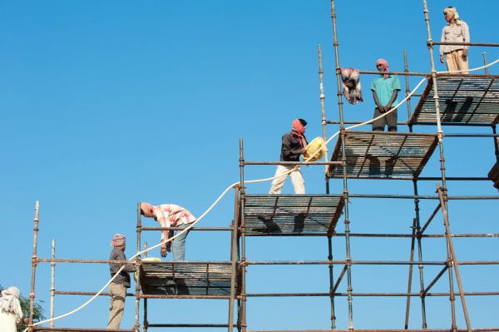
Despite widespread awareness of safe working procedures and equipment, falls from hieght remain one of the leading causes of workplace death and serious injury in India. Critics say problems such as time pressures and inadequate training lie at the root of many of these incidents, but others are hopeful that the new Occupational Safety, Health and Working Conditions Code will herald a reduction in falls by driving improvements in training, competence and supervision more widely.
Features
Fatal falls in India: why are the numbers not declining?
By
on 17 September 2026
India’s construction sector is the country’s second-largest employer and a major contributor to economic activity after the agricultural industry. India has overtaken the United States to become the world’s second-largest contributor to construction growth between 2020 and 2030, behind only China, according to Foundamental’s latest State of the Project Economy 2026 report. The Berlin-based venture capital firm focuses on technology for the architecture, engineering and construction industries.
When you travel across the country, you can hardly miss the signs of India’s construction boom: a new expressway here, a metro line there, an airport expansion elsewhere. Then there are the sprawling housing projects. From cities to smaller towns, construction is happening everywhere.
But there is a darker side to this explosive growth. Despite the billions of rupees pouring into the sector, there is scant regard for the safety of those who work at its lowest rungs.
Every year, hundreds of workers, both men and women, either fall to their deaths, are electrocuted, or are buried under rubble.
Soil collapse
The deaths of two labourers after a section of soil caved in during the construction of a road underpass in North Bangalore by the Bangalore Development Authority (BDA) on 11 August has once again put the spotlight on safety violations at construction sites and triggered calls for stricter safety guidelines and contractor accountability.
Girish Tumakuru, state general secretary of Karnataka State Construction and Quarry Labourers Federation trade union, pointed out that although advanced technologies and heavy machinery are available for underpass construction, labourers are still tasked with carrying out work at sensitive portions of the worksite, according to a news report by The Hindu. Five workers were positioned inside a 20-foot deep trench using a pump to remove accumulated monsoon rainwater in preparation for the installation of reinforced cement concrete when the wet earth suddenly gave way, fatally trapping two of them under the debris.
“Contractors don’t use any advanced technology and exploit labour,” Tumakuru told The Hindu. “Government officials, be it from the civic body or the Labour Department, must ensure that such precautionary measures are met, but even they ignore them.”
Tumakuru argues that the lack of strict rules and standard operating procedures for contractors means incidents of this nature are a regular occurrence. He adds that government agencies often fail to prosecute contractors for apparent breaches of safety law following serious incidents, and instead the deceased labourers’ relatives, or the surviving injured workers themselves, are simply paid compensation for the accident.
“In such civic sites, the deaths are at least reported, but in several industrial areas, many deaths go unreported,” he told The Hindu. “As many labourers are migrants, even their families won’t speak out, and the matter ends with issuing compensation.”
Construction deaths
Although the soil collapse at the underpass site in Bengaluru that claimed two lives hit the news headlines, it is far from an isolated case. Across the country, workers continue to lose their lives in accidents at construction and infrastructure sites, highlighting the often-deadly consequences of safety failures by construction and civil engineering contractors.
For instance, recent incidents in Noida illustrate just how quickly a lapse in safety measures can result in a fatality.
In an incident at an under-construction multi-storey building in Noida in February, a scaffolding collapse left two labourers dead and a third seriously injured.
In June, meanwhile, two workers died after falling from the 37th floor of an under-construction high-rise building in Noida’s Sector 152. According to local police, the workers were removing shuttering on the 37th floor of the building when the shuttering broke off. Although they had tied themselves on with safety belts designed to protect them in the event of a fall, as they fell, the belts gave way, causing them to plunge to the ground.
Commentators say serious safety lapses in industries like construction are not limited to private contractors, and government authorities have also been accused of negligence at building projects, including some overseen by the Brihanmumbai Municipal Corporation (BMC), the governing civic body of Mumbai, in Maharashtra.
In May 2026, two workers lost their lives after falling from an industrial gantry crane at a casting yard site for the Mumbai Coastal Road Project (Phase 2) in the Mira Bhayander area, a project being carried out by contractors commissioned by the BMC.
Meanwhile, in October 2025, the National Human Rights Commission NHRC India, said it had taken note of a media report about the death of a worker in a 10-foot fall at the IGI Airport in Delhi. The worker had been hired by a contractor for the construction work, and, according to news reports, it is alleged that attempts were made to suppress the incident by removing blood stains from the site of the fatal fall.
The NHRC observed that the contents of the media report, if true, raise a serious issue of a potential violation of human rights. Therefore, it issued notices to the chairman of the Airports Authority of India, and the Deputy Commissioner of Police of the IGI Airport Unit, Delhi, calling for a detailed report on the matter. The request included asking both parties for information on any compensation paid to the next of kin of the deceased worker.
Electrical hazards
Although falls from height are a serious problem in India’s construction sector, they are not the only safety hazard facing building workers. Electrical accidents, too, continue to claim lives, often exposing a different type of safety lapse at worksites.
In February 2026, in the Transport Nagar neighbourhood of Meerut in Uttar Pradesh (UP), a major commercial and logistics hub, a 27-year-old construction worker was electrocuted and fell from height while working on a hospital building, according to a report in Dainik Bhaskar.
According to media reports, Saif Ahmed, a resident of Muzaffarnagar city in UP, was working with several colleagues installing aluminium panels on the front elevation of the under-construction GC Khokhar Children’s Care Centre and Hospital. On the fateful day, he accidentally came into contact with an 11,000-volt high-tension power line running in front of the hospital.
According to witnesses, Saif was electrocuted, and the massive electric shock caused him to lose his balance, resulting in him falling from the building. He suffered critical injuries in the fall, although he survived.
Meanwhile, in August 2026, a 32-year-old labourer, named in media reports as Sheikh Aawaz Pasha Deshmukh, lost his life when he suffered a fatal electric shock while installing an electrical distribution pole and transformer in Majalgaon town, Beed district, Maharashtra.
The transformer was being installed on a bypass road, and Deshmukh and other labourers had climbed an electricity pole, reportedly after being told that the relevant power line had been shut down. However, during the work, the power supply was suddenly restored, and Deshmukh received a severe electric shock. He fell from the pole and was pronounced dead at the scene, reportedly being killed instantly.
According to AsianNetNews, the workers had been told that a shutdown permit had been obtained from the electricity department until 4pm, and, relying on this information, had climbed the poles and began work on the transformer. AsianNetNews says local police are now investigating whether adequate safety procedures were followed before the work began and how the line became energised during the expected shutdown period.
This type of work requires strict coordination between the electricity department, field staff and the contractor to ensure that electricity lines remain isolated while workers are exposed to them, reports AsianNetNews.
According to AsianNetNews, local police subsequently filed a FIR (First Information Report) for alleged safety negligence against four people associated with the electricity department and the contractor engaged by the electricity company to carry out the work. These are an assistant engineer from the electricity department, a lineman, a supervisor and a contractor.

Broader question
These various high-profile accidents raise a broader question about why safety incidents still occur with alarming regularity despite the apparent existence of safety procedures on many work sites.
“Every year, India loses thousands of workers to preventable falls from height” wrote Vanjul Jain, CEO & managing director of Y Group, an access equipment manufacturer, in a post on LinkedIn. “Not because we lack regulations. Not because we lack technology. Not because we lack awareness campaigns. We lose them because somewhere between the boardroom and the worksite, safety stops being a priority and becomes a checkbox.
“I have spent years in this industry, and if there is one thing I have learned, it is this: the gap between safety policy and safety practice is where lives are lost.”
Jain adds that a company can have the best safety manual in the country, “but if the supervisor on site hasn’t read it, if the scaffolding was assembled by an untrained crew, if the harness was purchased based on lowest cost rather than compliance, that manual means nothing”.
Unrealistic time frames
Safety experts say that in the construction industry, where many falls happen, there is a culture of contractors (and clients) expecting work to be completed in unrealistic time frames. This, they argue, creates pressurised deadlines for site managers and workers, which in turn contributes to a general culture of poor safety management in the sector: “When you’re under that stress, safety isn’t your priority,” said one safety expert.
Commentators add that significant numbers of construction contractors also fail to provide adequate supervision and training, which further impacts the sector’s safety culture.
The gap between written safety policies and what actually happens on worksites is not unique to India, however. Globally, falls remain a major cause of death and injury, according to various government statistics and academic research. An estimated 684,000 fatal falls occur globally each year, making falls the second leading cause of unintentional injury death, after road traffic injuries, according to the World Health Organization.
Over 80% of fall-related fatalities occur in low- and middle-income countries, with regions of the Western Pacific and South-East Asia accounting for 60% of these deaths. In all regions of the world, death rates are highest among adults over the age of 60.
Leading cause of occupational deaths
The International Labour Organization (ILO) recognises work at height as one of the leading causes of occupational injury and death worldwide. It recommends that governments globally adopt a risk-based, hierarchical approach to ensuring safe work at height, implementing legal and guidance frameworks that focus on effective principles and arrangements for fall prevention.
The ILO says employers should ensure work at height is properly planned, supervised and carried out by competent people with the skills, knowledge, and experience to do the job correctly and safely. It adds that those in control of the work must select and use the most appropriate type of access and related equipment for work at height.
However, the ILO stresses that duty holders should take a sensible approach when considering the most suitable precautions to prevent falls and other unsafe incidents connected to work at height, such as falling items like components striking and injuring people below. Low-risk, relatively straightforward tasks will require less planning and assessment, and there may be some low-risk situations where only simple, inexpensive precautions are required, it says.
Control measures
Before carrying out any work at height, employers should assess the risks, says safety experts. Factors to consider include the height of the task, the duration and frequency, and the condition of the surface being worked on.
In line with good safety management principles, employers should follow three simple steps:
- Avoid work at height where it’s reasonably practicable to do so
- Where work at height cannot be easily avoided, prevent falls using either an existing place of work that is already safe or the right type of equipment;
- Minimise the distance and consequences of a fall, by using the right type of equipment where the risk cannot be eliminated.
However, although these basic safety principles are long-established and well-known globally among a large proportion of employers, fatal falls continue to occur, particularly in industrial and similar settings.
Commenting on the common causes of worker fatalities in manufacturing industries in Karnataka state, K Srinivas, director of the state’s Department of Factories, Boilers, Industrial Safety and Health, told The Times of India falls from height account for around a quarter of all worker fatalities in factories and related manufacturing workplaces.
He added there is a recurring pattern of fatalities due to workers falling from heights of 10 to 20 feet in industrial units across Karnataka state. He added: “Hiring workers unfamiliar with the worksite and failing to follow safety protocols are the primary reasons behind these accidents.”
However, Srinivas is hopeful that recent changes to India’s occupational safety regulatory framework will help address these risks.
“The Occupational Safety, Health and Working Conditions Code, 2020, which prohibits engagement of contract labour in core areas of industries, is expected to help reduce accidents at industrial units,” he said. “The code mandates that an educated and skilled workforce must be deployed in core operational areas. Employing contract workers without the required skill set often leads to violations of safety protocols.”