
Another spate of fatal fires in unsafe urban buildings has again highlighted failures by India’s authorities to clamp down on illegally constructed commercial buildings. However, commentators say a recent Supreme Court warning that local authority officials may be held personally liable for failing to close unsafe establishments offers hope that more effective enforcement will drive down the number of devastating blazes
Features
India’s fire safety problem: how urban fire tragedies are driving demands for more effective building safety enforcement
By
on 14 August 2026
It is likely that many of the 15 people who lost their lives when fire swept through a multi-storey commercial building in Lucknow’s upscale Aliganj area in June would have survived if appropriate fire safety features, equipment and arrangements had been in place, fire safety experts have warned in light of the widely-reported tragedy.
According to the News 18 media channel, the three-storey building housed a pet shop on the ground floor, a company involved in 3D art production and game development on the second floor, and an IT networking office on the third floor. Most of those who lost their lives were employees working at the 3D art production studio, known as Head Hopper Studios.
Both fire safety experts and firefighters involved in battling the blaze say multiple structural and fire safety failures turned the building into “a disaster waiting to happen”.
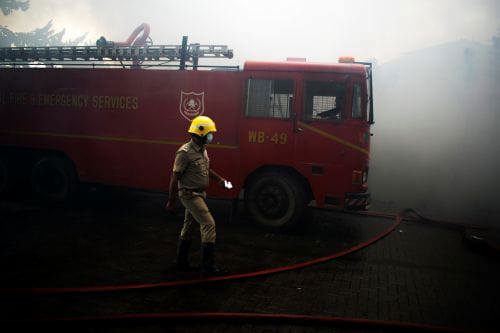
Investigators allege the building lacked basic fire safety infrastructure, including inadequate fire-fighting arrangements, no dedicated emergency exits and no mechanism to ventilate smoke from the building.
According to an FIR (First Information Report), lodged at Aliganj police station, the building had only a single entry and exit point, and there was no alternative emergency escape route for the occupants. The FIR also records various alleged electrical installation failings and claims that air-conditioner outdoor units and other electrical equipment had been installed without proper safety precautions.
Struggle to fight blaze
According to media reports, firefighters initially struggled to enter the building as the only access point was blocked by intense flames and thick black smoke. As a result, rescue teams were forced to access the terrace of an adjoining premises and break through a rear wall to gain entry to the building while the fire was still raging. Police constables used sledgehammers to smash two openings in the commercial building’s wall, a process that took about an hour. Relatives of several victims have alleged that precious time was therefore lost as rescuers struggled to get into the building to try to evacuate and save people.
Videos on social media showed people climbing out of broken windows, with one appearing to show a man falling from an upper floor while trying to escape. Local media reported that he survived and was hospitalised.
Recalling the terrifying moments, Mohd Aasif, who worked at the animation centre, told Press Trust of India that he and his colleagues had just begun eating lunch around 2pm when they were told that something had gone wrong and everyone needed to leave immediately. “We were not told that there was a fire. We thought it could be a minor short circuit as something similar had happened earlier,” said the 32-year-old.
The studio featured a biometric entry-and-exit system, but when Aasif and other workers tried to exit through the biometric lock, they had to spend several seconds trying to operate it as a power failure caused or connected to the fire allegedly caused the access system to malfunction.
By the time the door finally opened, thick smoke had begun filling the second floor where the animation company was based. The staircase, the only escape route available to workers on the second floor, was a tunnel of smoke and flames.
“When we moved towards the staircase, we saw thick smoke coming from there. We then moved towards the front, but smoke was coming from there too,” said Aasif.
Within minutes, visibility had declined so severely that colleagues standing just a few feet apart could no longer see each another.
Desperate for air, Aasif grabbed a desk and smashed a glass window. Wrapping a wet towel around his face, he tried to breathe through the smoke.
“When I broke the glass, I saw flames outside and people below were asking us to jump,” he told PTI.
Aasif said that at that moment he realised there was no way out and decided to jump from the front of the building.
“I felt jumping was the only option because staying inside meant certain death,” he recalled.
“I saw an electric wire in front of the building. I did not know whether it had power or not,” he said, adding that the wire was melting due to the heat and he suffered injuries while falling.
According to Aasif, the staircase connecting the floors acted like a chimney, allowing smoke and flames to rise rapidly.
“The terrace [exit door] was locked. If that exit had been open, many lives could have been saved,” he said.
Inadequate fire safety arrangements
Aasif added that more than 20 people were present in the building at the time of the incident and alleged that the building lacked adequate fire safety arrangements.
“There was no working fire alarm,” he said. “Some safety equipment was present, but initially we could not locate the source of the fire because only smoke was visible.”
There has been no independent confirmation of Aasif’s claims, and, at the time of publication of this article, the authorities stated they were continuing to investigate the cause of the blaze and any alleged fire safety failings at the site.
Aasif said his colleague Jayant Gupta also jumped from the building and suffered severe injuries.
“He fell on an iron railing and was badly hurt. He remained on the road in pain until some people took him to a hospital in an auto,” he said.
“I suffered severe injuries, but I am recuperating now,” Aasif told PTI.
Four individuals have reportedly been arrested in connection with the incident, including the joint owners of the building.
Preliminary investigations suggest the fire may have started in the building’s air conditioning duct. “With no exit route available, smoke caused fatal suffocation,” said Uttar Pradesh’s urban development and energy minister A K Sharma. The minister added that the investigation by police and local authorities would also examine if there were lapses in building standards at the site.
Four public officials have also reportedly been suspended, including officials from the electricity department, fire department and Lucknow Development Authority (LDA), which oversees building applications. permissions and controls.
“On the directions of Uttar Pradesh chief minister, four persons have been suspended with immediate effect,” the Uttar Pradesh (UP) Government said in a statement. “They are: Gaurav Kumar (executive engineer, Collection of Electricity Department), Kamlendra Kumar Singh, FSSO (Fire Department) Indira Nagar, Anil Kumar AE (LDA), and Pramod Kumar JE (LDA).”
After the fire tragedy, the LDA issued a demolition notice for the Aliganj building, stating it had been constructed illegally, and the owners were therefore required to demolish it within 15 days. However, the UP government said in a statement that a demolition order had previously been served on the building in 2016, alleging it was an authorised structure. However, two months after the demolition order was served, it was revoked in July 2016, raising questions about the circumstances under which the decision was reversed, the statement added.
People living near the Aliganj premises told media outlets that the presence of unsafe commercial buildings in densely populated residential areas poses a “ticking time bomb” for the safety of both the building occupants and nearby residents. “If commercial buildings continue to operate in residential areas by ignoring rules, the consequences can be disastrous,” they said.
High-profile fatal blazes
In India, devastating fire incidents regularly hit the headlines, and every year, the country experiences numerous high-profile fatal blazes, including in commercial establishments. Experts say that while the frequency of these incidents is clearly alarming, it is equally concerning that many serious and fatal blazes are the direct result of repeated and persistent failures by building owners to comply with basic building and fire safety laws. They add that the situation is aggravated by failures by building, fire and municipal authorities to strictly enforce existing fire and building safety regulations.
According to data released in 2017, India has less than 3,000 fire stations, despite experts suggesting the minimum required to meet the scale of the nation’s fire risk is 8,559. The data also revealed that fire departments across the country have staffing levels almost 600,000 below the minimum level considered appropriate for managing and dealing with the extent of the existing fire risks. Meanwhile, other statistics show that, on average, 51 people die every day as a result of fire incidents.
Although understaffing of local and state-level fire services is considered to be a critical issue among fire safety experts, it is just one aspect of a larger problem involving poor fire safety in large numbers of commercial buildings.
The illegal construction of buildings in dense town and cities, with buildings erected in awkward to reach locations such as narrow alleyways, makes it extremely difficult for firefighting vehicles and equipment to reach the affected areas in the event of a fire. Buildings are often erected without permission, lack critical fire safety measures – such as adequate emergency exits and fire alarms – and sometimes include sleeping accommodation, with workers sleeping in rooms above workshops where processes and materials that pose serious fire hazards are present. The problem is compounded by local fire and municipal authorities lacking the staffing and resources to inspect, close and order the demolition of these unsafe structures.
Delhi fire tragedy
A tragic example of this lethal mix of fire dangers occurred in Delhi on 8 December 2019, when 43 labourers lost their lives after a blaze swept through a manufacturing unit in the Anaj Mandi district at 5am. The factory, located in an old, cramped quarter of the city, doubled as a sleeping space for migrant labourers trying to save money on housing costs by staying at their workplace.
When the blaze broke out in the early hours as the occupants were sleeping, narrow staircases, windows with metal security grilles on them and a locked terrace turned the combined factory and dormitory building into a death trap. Fire investigation officials noted afterwards that the building had just one narrow exit, as a second exit was blocked by raw materials. This, and the fact that each floor had barely any ventilation to remove choking smoke as the fire caught hold, meant the labourers, most of whom were from Bihar and Jharkhand, had little chance of escaping.
Meanwhile, local fire service vehicles struggled to navigate an alleyway barely wide enough for a single vehicle where the building was located, drastically slowing and hampering the emergency response.
Commenting on the inadequacy of current urban planning procedures and planning enforcement for the construction and occupancy phases of buildings, SS Warick, director of Maharashtra Fire Services and chief fire officer at Maharashtra Industrial Development Corporation (MIDC) Fire Service, said suitable and appropriate fire safety structural features, equipment and risk management arrangements must be embedded in project planning from the design stage onwards, rather than being treated as a post-construction compliance requirement.
“Most modern buildings have an age of five to six decades,” he said. “Decisions taken at the planning stage determine how effectively a structure can prevent or withstand fire emergencies throughout its lifecycle. Properly designed and maintained fire protection systems can significantly reduce casualties and economic losses.”
Improved awareness and enforcement
Fire safety experts add that to help minimise fires and reduce the risk of loss of life and property, there needs to be improved education and awareness so building developers, owners and managing occupiers have a much greater knowledge of fire prevention procedures and emergency procedures for fire incidents. However, this needs to be backed up with much more effective enforcement of planning and construction rules, plus much more frequent and effective inspections and checks on the adequacy of fire safety arrangements during the occupancy phase.
“We hear of fire incidents being reported from different parts of the country,” said one fire safety expert. “They could all be prevented or contained, and the damage minimised or precious lives saved if precautions were taken, and rules enforced. Unfortunately, no lessons are learnt from these disasters. A few people are arrested, or suspended, and enquiry commissions are set up. But cases drag on for years, often without the culprits getting sentenced. Firefighting infrastructure remains grossly inadequate.
“Unless fire prevention becomes integral to everyday life and law enforcement is taken seriously, fire incidents will continue without end.”
Following the Delhi Anaj Mandi fire tragedy in 2019, Valter Sanches, general secretary of IndustriALL a global union federation that represents more than 50 million workers in 130 countries, stated, “Our experiences through the Bangladesh Accord on Fire and Building Safety reinforce the fact that the involvement of unions is indispensable to improve safety at the workplace. The Indian Government and employers should work with unions to improve the occupational safety and health situation in the country.”
Glimmer of hope for genuine action
Commentators argue, however, that repeated recent fire tragedies in India may finally be starting to drive genuine, structural reform rather than mere empty promises.
For instance, the Supreme Court recently warned civic authorities in Delhi, Gurugram and Lucknow that officials from these bodies could be held personally liable if they fail to take action to remove unauthorised buildings and structures. Citing recent fatal fire incidents, the court directed these local authorities to enact stricter enforcement for illegal and unsafe buildings, ordered officials from these civic bodies to personally appear before the courts to explain the actions they are taking to close and remove unsafe buildings, and warned of contempt proceedings for officials if they fail to comply with the court’s instructions.
Meanwhile, in a separate move, the Delhi-NCR Government launched a crackdown on properties violating fire safety rules after a fire at a hotel in capital city in June this year claimed the lives of 23 people, including 12 foreign nationals.
The ongoing enforcement drive has primarily focused on the densely populated Central district of Delhi, which has recorded the highest number of notices issued by both the revenue department’s sub-district committees and the Delhi Fire Services (DFS).

FEATURES
Eliminating barriers in reporting: how conversational AI can unlock safety engagement
By on 01 January 0001
Why UK employers need to rethink recruitment, retention and support for older workers
By on 01 January 0001