Church House, located in Westminster, has had many incarnations but a defining moment was as temporary Parliament during World War II.
News
ISA conference hears the power of value-driven leadership
By
on 06 July 2026
The challenges that shape our age may look different to that time, but adaptability in the face of unprecedented change remains a topical concern and was a central theme explored at the inaugural International Safety Awards conference held last week on 19 June.
With technology moving fast, the panel session Leadership in a digital world was particularly insightful in exploring ideas of how to succeed during times of change.
“Good leaders make safety a value, not a priority,” said Paul Mahoney, motivational speaker and founder of Inspiring Safety Ltd, in fielding a question hinged on how leaders can ensure competing distractions do not detract from safety.
“If you make safety a value, everyone lives that value rather than it being event-driven,” he explained.
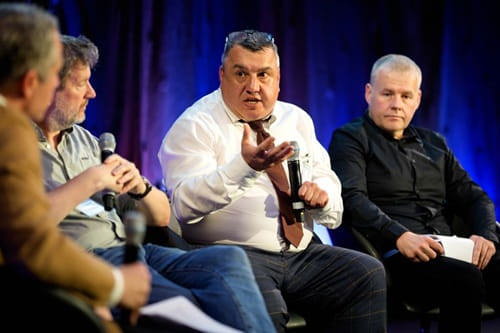 British Safety Council’s Ian Cooke chaired the panel on Leadership in a digital world featuring L to R: Duncan Davies, Paul Mahoney and Dylan Skelhorn. Photo by Harry Richards photography
Technology can enable managers to be more mobile, ready to assess risk live on site, as well as enable CEOs to have a direct line to what’s happening on the ground.
Duncan Davies co-founder of Notify Technology said that, through their technology, leaders can access incidents as soon as they’ve happened. This means they can be at an injured worker’s side moments after an event. “Tech is the biggest opportunity to connect leaders in ivory towers with workers. It creates more corridors for communication because as a leader you can’t be everywhere.”
Using CCTV is becoming common practice to monitor safe behaviour, and Dylan Skelhorn, motivational safety and keynote speaker, said that this is a “good thing, but we can’t rely on it.”
Fifteen years ago, while working as a solid fuel heating engineer for a small company that specialised in chimneys and roofing, he was told his company had a “dispensation from HSE to work without work at height harnesses.” Building a culture where people feel psychologically safe to raise concerns is more powerful than CCTV he suggested: “If there’s fear, people don’t speak up. It’s the unwritten rule.”
Are there challenges to using the array of technologies too? “It’s neither one nor the other,” said Davies. There’s a risk health and safety professionals can become “slavish” to technology and “fill the spreadsheets.”
It was also discussed how technology isn’t only empowering for leaders but for workers too, and that this ultimately can be good for organisations. Because teams are better briefed ahead of a job or piece of work thanks to agile technology, “tech can give workers the power to stop unsafe work,” said Mahoney.
“It used to be that as a leader you know everything, that’s not the case now. AI means (everyone) is more informed. It’s about supporting teams to [go in a direction],” said Davies.
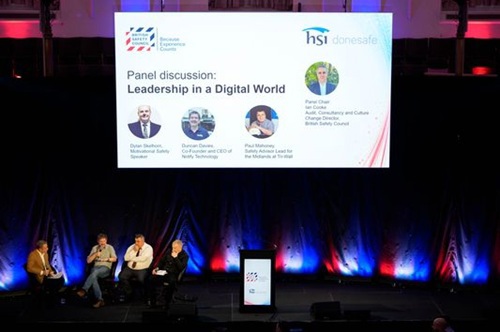 The panel spoke as part of the ISA Conference held at the iconic Church House venue in Westminster. Photo by Harry Richards photography
The ISA Designing Safer Workplaces conference was held on 19 June. More information here