
Vehicle paint sprayers face an elevated risk of developing debilitating occupational asthma from exposure to isocyanates found in certain ‘2-pack’ paints, coatings and lacquers, so HSE is encouraging motor vehicle repair businesses to prevent or minimise exposure through a mix of education, advice and enforcement.
Features
Paint spraying: why motor vehicle repair workshops need to tackle the asthma risk
By
on 01 April 2026
Isocyanates are one of the leading causes of occupational asthma in the UK. They are used in many industries in paints, lacquers, glues, foams and other polyurethane products.
Some 20 years ago, HSE identified that motor vehicle repair (MVR) paint sprayers were substantially more likely to develop occupational asthma than any other job description. As a result, a nationwide awareness campaign was launched with over 30 MVR Safety and Health Awareness Days held around the country.
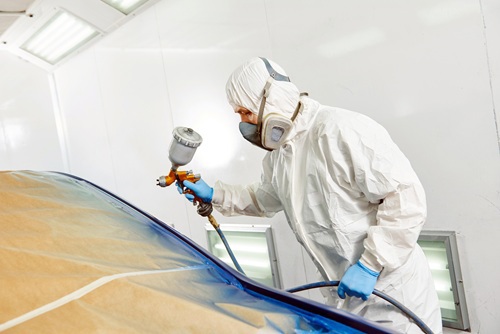 Motor vehicle repair (MVR) paint sprayers are substantially more likely to develop occupational asthma than any other job description. Photograph: iStock
These targeted bodyshop managers and sprayers and provided advice on how to work safely with isocyanates, including identifying symptoms and getting health checks, using the right equipment correctly, and training and checking control measures. These events, alongside an inspection campaign, led to a significant reduction in sprayer exposures (as measured by urine sampling) and a reduction in the number of reported cases of occupational asthma.
Since then, much of the industry workforce has been renewed; attendees from those workshops may have now left the industry and those messages may have been lost within businesses. Rates of occupational asthma amongst vehicle paint sprayers are once again on the rise and exposures are again increasing. HSE has therefore committed to renewing and refreshing the health and safety advice around isocyanates in this sector, alongside a significant inspection initiative.
Guidance on safe use of isocyanates
Information and resources on safe handling and use of isocyanates within the motor vehicle repair sector has been revised and updated and made available on the WorkRight site. This website provides relevant advice and guidance
on key areas, namely:
- Control measures – including the spray facilities and the appropriate air-fed breathing apparatus. The need to measure the ‘clearance time’ of the booth or room and to inform employees of what the clearance time is, how long it is for the facilities in use (the time should be displayed at the entrance of the booth), and how and why to comply with it in everyday work.
- Legal duties – including the need for appropriate training (as required under UK REACH), risk assessments, maintenance of equipment and health surveillance.
- Health surveillance – this has been a legal requirement for those using isocyanate-containing products for decades. Workers should be assessed and should have a health questionnaire and respiratory health surveillance (lung function testing) at least annually and should have regular skin checks (to identify possible dermatitis).
- Monitoring exposure – despite all the control measures in place and appropriate training, it is important to check that these are all working as intended to prevent exposure to workers. The easiest way to do this is through a urine test. This test checks whether any isocyanate has got into the body through the skin, from hand-to-mouth contact or (most likely) through breathing in the invisible paint mist in the booth. Because the concentrations in the booth during spraying are very high, even a very short exposure (such as visor lifting, which should never be done when spray is present), can lead to detectable levels in urine. HSE has recommended urine sampling for more than 15 years and has had a guidance value in place since 2015. If a urine sample result exceeds the guidance value, then action must be taken to identify the cause of exposure and rectify it. Re-sampling is then required to ensure that the steps taken have addressed the issue.
Inspection programme
Alongside an extensive social media campaign and engagement with stakeholders such as occupational health professionals and relevant trade associations, HSE inspectors are conducting around 1,000 inspections of bodyshop repair garages that undertake vehicle paint spraying.
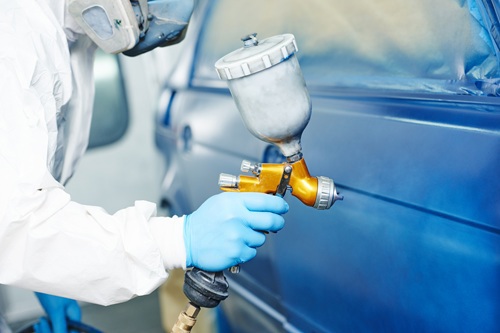 We know the recommended control measures and good working practices can prevent isocyanate exposure in spray painters. Photograph: iStock
These inspections will be looking for adequate risk assessments and training of staff, suitable control measures being used appropriately, a sustained health surveillance programme and evidence of exposure monitoring (ideally by urine tests), with improvement actions having been taken when results indicate it is necessary.
Remember, every year, vehicle paint sprayers develop asthma, a life-changing condition. Once they have it, even tiny amounts of isocyanate exposure can trigger an attack, which often forces them to leave the profession completely.
We know that the recommended control measures and good working practices can prevent isocyanate exposure in spray painters, which in turn prevents workers developing occupational asthma. Visit the HSE website for specific advice on MVR health and safety requirements and the WorkRight site for the isocyanate resources, including a knowledge quiz.
Share this information with your professional (maybe you are a paint supplier or equipment manufacturer?) and personal (perhaps you have friends or family working in MVR?) networks. Together we can raise the awareness of the dangers of isocyanate exposure and the essential steps to manage the risks.
For more information see:
hse.gov.uk/mvr/bodyshop/index.htm
workright.campaign.gov.uk/isocyanates
Kate Jones is Team lead – Biological Monitoring Team, Science Division, at HSE

FEATURES
Eliminating barriers in reporting: how conversational AI can unlock safety engagement
By on 01 January 0001
Why UK employers need to rethink recruitment, retention and support for older workers
By on 01 January 0001