
Many employers provide sit-stand desks in a well-intentioned bid to avoid the health and productivity problems arising from prolonged sedentary working, but this approach is doomed to fail unless it forms part of a wider, everyday workplace culture that encourages and promotes ‘active working’ and regular exercise.
Features
Why sit-stand desk investments fail without an active working strategy
By
on 03 June 2026
For more than a decade, I have been campaigning to raise awareness around the dangers of prolonged sedentary behaviour at work. When I launched the ‘Get Britain Standing’ campaign in 2014, many people still viewed excessive sitting as simply a normal part of modern office life. Today, awareness has changed dramatically.
Most employers now recognise that sitting for seven to 10 hours a day can contribute to musculoskeletal problems, obesity, type 2 diabetes, cardiovascular disease, poor mental wellbeing and reduced productivity.
Sit-stand desks, walking meetings and movement-focused workplace initiatives have all become far more common, with organisations across the UK investing heavily in workplace wellbeing and ergonomic equipment.
However, as ‘active working’ has evolved, a new challenge has emerged.
 Musculoskeletal disorders (MSDs) remain one of the leading causes of workplace absence and reduced productivity. Photograph: iStock
Many employers have successfully installed sit-stand desks, but far fewer have successfully changed employee behaviour.
In my experience, this is now one of the biggest gaps in workplace wellbeing strategy. The conversation is no longer simply about whether organisations should provide sit-stand desks, but how employers can create a genuine culture of movement that improves health, wellbeing and performance – both in the office and when working from home.
The science has evolved
When sit-stand desks first entered the mainstream, much of the conversation focused on standing more and sitting less. While reducing prolonged sitting remains important, the science around sedentary behaviour has become far more nuanced.
A 2024 study led by researchers at the University of Sydney suggested that prolonged standing alone may not offset the health risks associated with sedentary behaviour and, in some cases, may contribute to circulatory or musculoskeletal issues if individuals remain static for long periods.
This is an important point, and one that the ‘Active Working’ movement has consistently emphasised for many years.
The original workplace guidance published in 2015 by the British Journal of Sports Medicine and commissioned by Public Health England and Active Working CIC did not advocate standing all day. Instead, it encouraged workers to:
- Incorporate at least two hours of standing or light movement throughout the working day
- Regularly alternate between sitting and standing
- Break up prolonged sitting
- Avoid prolonged static standing.
The goal of the wider ‘Active Working’ movement has never been to replace one static posture with another, but to ensure we get to the two-hour guidance level and break up prolonged sitting. The human body is designed for movement and variation, not prolonged inactivity in either a seated or standing position.
In practical terms, healthier workplace movement should include:
- Regular posture changes
- Short walking breaks
- Standing collaboration sessions
- Movement during phone calls
- Walking meetings
- Stretching and mobility exercises
- Reducing long, uninterrupted periods in any single posture.
This balanced and evidence-led approach is becoming increasingly important as employers seek practical ways to support workforce wellbeing in hybrid working environments.
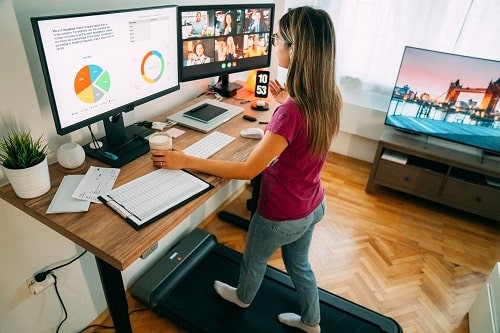 One of the biggest mistakes employers continue to make around stand-up desks is measuring installation rather than engagement. Photograph: iStock
The hidden problem with sit-stand desk investment
Over the past five years, many organisations have invested substantial sums in sit-stand desks and ergonomic workplace equipment and fortunately, prices have come down significantly. Yet one of the biggest mistakes employers continue to make is measuring installation rather than engagement.
An organisation may successfully deploy hundreds of sit-stand desks across a workplace, but if employees rarely use the standing function consistently or correctly, the expected health and productivity benefits are unlikely to materialise. The key enemy here is ‘inertia’.
In fact, many facilities and workplace managers privately acknowledge that the majority of sit-stand desks become significantly underused after the initial rollout phase.
Some estimate that “up to 95%” of employees fail to use their sit-stand desks effectively or consistently without ongoing engagement, education and behavioural support. When you ask around different workplaces this is anecdotally both widespread and global.
This challenge is far more common than many employers realise.
In many workplaces, employees initially experiment with their sit-stand desk but gradually revert to prolonged sitting habits within weeks or months. Often this happens because:
- Employees receive little or no guidance on how to use the desks effectively
- There are no prompts or reminders to encourage movement
- Managers do not role model active working behaviours
- Standing becomes uncomfortable because employees try to stand too long too quickly
- Active working is treated as a furniture project rather than a behavioural change initiative
- Home workers become disconnected from workplace wellbeing culture.
- Awareness alone rarely changes long-term habits.
Why this matters more than ever
This issue is not simply about workplace comfort or wellbeing trends. Sedentary behaviour is becoming a major economic and workforce sustainability challenge for employers across the UK.
Musculoskeletal disorders (MSDs) remain one of the leading causes of workplace absence and reduced productivity, while presenteeism, where employees are physically present but operating below full cognitive and physical capacity, is estimated to cost UK businesses billions of pounds annually.
At the same time, the UK workforce is ageing, with many employees now expected to work later into life, often in highly sedentary desk-based roles.
For employers, this creates a significant hidden cost challenge.
Prolonged sedentary behaviour has been associated not only with poorer physical health outcomes, but also reduced energy, lower concentration, mental fatigue and decreased workplace engagement. In hybrid working environments, where employees may spend even longer periods seated at home without natural movement triggers, these risks may become further amplified.
Importantly, evidence emerging from the SMART Work & Life project has demonstrated that when sit-stand desks are combined with proper behavioural support and engagement strategies, employees can reduce sedentary time by more than one hour per working day.
The project also identified potential productivity gains valued at approximately £1,600 per employee per year through improvements in wellbeing, engagement and performance.
What SMART Work & Life has taught us
This is one of the key lessons emerging from the SMART Work & Life project, a workplace behaviour and movement initiative led by medical professionals and academics at Leicester Diabetes Centre that explores how behavioural prompts, habit formation and self-awareness can support healthier workplace movement patterns.
The SMART research reinforces several important principles:
- People often overestimate how much they move during the day
- Small behavioural nudges and prompts can significantly influence movement habits
- Movement needs to become part of organisational culture
- Regular reinforcement is essential
- Personalised approaches are often more effective than generic wellbeing messaging
- Hybrid workers may be at greater risk of prolonged sedentary behaviour due to fewer natural movement triggers during the day.
One of the most important lessons from SMART is that workplace wellbeing interventions are significantly more effective when equipment is combined with behavioural engagement strategies. Simply giving employees a sit-stand desk does not automatically create healthier movement habits.
 Healthier workplace movement should include short walking breaks and walking meetings. Photograph: iStock
The future of Active Working therefore lies in combining workplace design, behavioural science and organisational culture.
What should employers actually do?
One of the questions I am most commonly asked by employers is: “We have already bought sit-stand desks. They are rarely used and we have no idea what we should do next?”
The answer is that Active Working needs to become part of everyday workplace culture rather than a one-off furniture installation project.
An effective Active Working engagement plan should typically include:
- Employee education and onboarding
- Practical guidance on how to use sit-stand desks correctly
- Encouragement to gradually build movement habits
- Reminders and prompts throughout the day
- Leadership participation and role modelling
- Walking meetings and active collaboration
- Support for hybrid and home workers
- Regular awareness campaigns
- Measurement and review of employee engagement.
Importantly, employers should encourage gradual adaptation rather than prolonged standing. Employees who suddenly attempt to stand for hours at a time may experience fatigue or discomfort, which can discourage long-term adoption.
Small and sustainable behaviour changes are generally more effective than aggressive or unrealistic wellbeing targets.
Choosing the right Active Working equipment
There is now a huge range of Active Working products available to employers, but not every solution is appropriate for every worker or environment.
Sit-stand desks remain one of the most practical and scalable workplace interventions because they allow employees to regularly alternate between sitting and standing throughout the day. However, employers should ensure desks are properly assessed, ergonomically suitable and supported with guidance on correct usage.
Desk converters and risers can provide a lower-cost alternative where full desk replacement is not possible, although some users may find them less flexible or ergonomically effective over long periods.
Anti-fatigue mats can be useful for employees who stand regularly, helping reduce pressure on the feet and lower limbs.
Most importantly, a mat will encourage users to make micro-movements with their feet, thereby circulating blood more around the feet and ankles, and as a result, both reduce fatigue and improve posture. Active seating, stools and wobble chairs may also help encourage movement variation and dynamic posture, though they should not be viewed as replacements for regular movement breaks.
Desk bikes and treadmill workstations can be beneficial in certain environments, particularly for short periods of low-intensity activity, but they are unlikely to be suitable for all roles or all employees.
Employers should be careful not to create unrealistic expectations or introduce equipment that may become distracting, impractical or underused.
Ultimately, no piece of equipment should be viewed as a standalone solution. The most effective workplaces combine ergonomic design with education, behavioural support and organisational culture.
Measuring behaviour, not furniture
One of the biggest opportunities for employers in 2026 is improving how workplace wellbeing interventions are measured.
Historically, organisations have often measured:
- How many sit-stand desks were installed
- How much equipment was purchased
- How many employees attended wellbeing sessions.
But these metrics do not necessarily indicate whether healthier workplace behaviours are actually occurring.
To help address this challenge, Active Working CIC (Community Interest Group) has developed the Active Working Scorecard, a practical workplace assessment framework designed to help organisations better understand movement behaviour and engagement across their workforce.
The scorecard helps employers assess:
- Employee sitting and movement habits
- Frequency of posture change
- Engagement with sit-stand desks
- Home working movement behaviours
- Leadership support for active working
- Workplace culture and behavioural barriers
- Employee perceptions around energy, focus and wellbeing
- Awareness and understanding of healthy movement practices.
The purpose of the scorecard is not simply to encourage people to stand more. Instead, it is designed to help organisations create healthier and more sustainable movement behaviours throughout the working day.
For many employers, the results can also help build a clearer internal business case for future wellbeing investment, training or workplace interventions.
Active Working at home
Hybrid and remote working have created additional challenges around sedentary behaviour.
In traditional office environments, workers often benefit from natural movement triggers such as:
- Walking to meetings
- Commuting
- Visiting colleagues
- Moving between spaces.
At home, many of these natural movement opportunities disappear.
Employees may remain seated for longer periods, work from unsuitable furniture, skip breaks and become disconnected from workplace wellbeing initiatives.
As a result, employers should ensure Active Working strategies extend beyond the physical office and include:
- Guidance for home workstation set-up
- Regular movement reminders
- Virtual walking meetings where practical
- Wellbeing check-ins
- Movement-based challenges and campaigns
- Consistent communication around healthy work habits.
The future of Active Working
The workplace wellbeing conversation is continuing to evolve.
Ten years ago, when I ran the Active Working Summits bringing together government, health charities, researchers, key business stakeholders and workplace leaders, the challenge was raising awareness around the dangers of prolonged sitting.
Today, the challenge is helping organisations turn awareness into sustainable behavioural change.
The future of Active Working is not about creating standing offices. It is about creating movement-enabled workplaces where employees are encouraged and supported to move regularly throughout the day.
The organisations that achieve the greatest long-term wellbeing benefits are unlikely to be those with the most furniture, but those with the strongest culture of movement, engagement and behavioural support.
Free Active Working Scorecard for employers
As part of the ongoing Active Working and Get Britain Standing initiatives, employers interested in better understanding sedentary behaviour and movement patterns within their workforce can now access the basic Active Working Scorecard at no cost.
The scorecard is designed to help organisations benchmark current behaviours, identify engagement gaps and better understand whether existing sit-stand desk and workplace wellbeing investments are delivering meaningful value.
More advanced and enhanced versions of the Active Working Scorecard are also being developed to provide deeper behavioural insights, reporting and engagement analysis.
Employers considering future investment in sit-stand desks or Active Working initiatives may also find the scorecard useful in helping shape their workplace strategy and employee engagement plans.
Organisations interested in conducting a free Active Working Scorecard within their workplace, or learning more about future participation in On Your Feet Britain 2027, can contact:
[email protected]
For more information see:
yo-yodesk.co.uk
[email protected]
Gavin Bradley is founder of Active Working CIC and Get Britain Standing and chief wellness officer at Yo-Yo OFFICE®
Five mistakes employers make with sit-stand desks
- Treating sit-stand desks as a furniture project
Successful Active Working requires behavioural engagement, not simply procurement. - Encouraging employees to stand too much too soon
Gradual adaptation is essential. Excessive static standing can create discomfort and disengagement. - Failing to educate employees
Many employees receive little guidance on how or when to use their desk effectively. - Ignoring home workers
Hybrid workers are often at greater risk of prolonged sedentary behaviour than office workers. - Measuring installation instead of engagement
The real success metric is behaviour change, not the number of desks purchased.
FEATURES
Eliminating barriers in reporting: how conversational AI can unlock safety engagement
By on 01 January 0001
Why UK employers need to rethink recruitment, retention and support for older workers
By on 01 January 0001