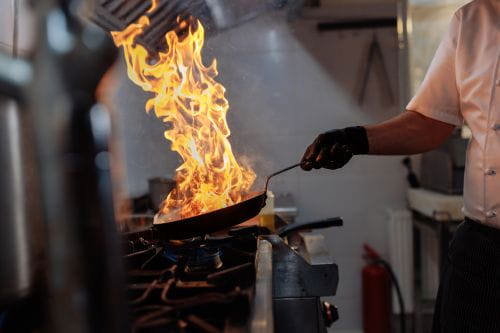
With research showing that chefs in India’s commercial kitchens are regularly exposed to high levels of harmful air pollutants, calls are growing for the country’s ever-growing restaurant and catering industry to switch to cleaner cooking methods and install effective mechanical ventilation systems.
Features
A toxic cocktail: inside India’s smoky commercial kitchens
By
on 17 April 2026
hen New Delhi experiences toxic smog every winter, advisory announcements from public health officials urge older people, children and those with respiratory conditions to minimise the time they spent outdoors to reduce their exposure to harmful air pollutants. However, dangerous levels of air pollution are not just a health hazard for those exposed outdoors in cities to pollutants like vehicle fumes, construction dust and smoke from agricultural stubble burning in neighbouring Punjab and Haryana – workers in restaurant kitchens where gas, wood or other solid fuels are used to cook and heat food are also at risk of respiratory illnesses, cardiovascular diseases and even cancer.
“We often connect pollution with traffic in cities and industries, but some of the worst air we breathe is inside restaurant kitchens,” says Ramesh Gupta, a cook in a restaurant in Noida city in Uttar Pradesh. “For the country’s millions of cooks, food handlers and service staff like me, exposure is not seasonal; it is constant.”
When asked if he considers cooking fumes a major source of pollution, Ramesh says: “Definitely, yes. I work for no less than 12 hours a day, six days a week, and I have to endure terrible headaches from the first tadka (frying of spices and herbs in hot oil) for a dal fry or something similar. This hourly ritual creates a silent cloud of pollutants that lingers long after the tadka fades. Even on Sundays, my headache refuses to go away.”
Indoor air pollution levels
This lived experience reflects a broader, often overlooked aspect of India’s pollution crisis: indoor air pollution levels can often be higher than those outdoors.
In a study led by Professor Aditya Vaishya at Ahmedabad University, researchers installed particulate matter (PM) air quality sensors across three types of spaces: an outdoor location, a standard indoor space (such as a classroom or office), and an indoor space with an active pollution source like a burning stove. The study monitored levels of particulate matter (PM), ozone, temperature and relative humidity. The findings challenged the commonly-held belief that indoor air is safer. In fact, PM concentrations indoors were higher than the outdoor levels for more than 50 per cent of the time, regardless of whether a pollution source was present.
Therefore, while it is widely recognised that India experiences some of the worst outdoor air pollution in the world, our understanding of the nature and extent of indoor air pollution in workplace environments like commercial kitchens in India – and the level of regulation of the health risks – are at a much earlier stage.
When food is produced in large quantities, whether in a restaurant, hotel, ‘cloud’ kitchen (commercial catering unit fulfilling home delivery orders from phone apps), industrial canteen or food court, chefs and other kitchen workers inhale toxic air.
“In confined spaces such as commercial kitchens, pollutants tend to accumulate and linger, resulting in prolonged exposure to harmful particulate matter (PM) and toxic gases such as volatile organic compounds (VOCs), nitrogen oxides (NOx) and ozone,” say environmental experts. “These are often released during activities like deep frying, using wood-fired stoves, spraying air fresheners and using cleaning agents.” In fact, an analysis by the American Chemical Society suggests cooking a roast dinner produces more particulates than you’d find on a typical Delhi street.
Constant exposure to smoke and steam, grease-laden vapours, odours and harmful gases, as well as excess heat from cooking equipment like fryers, ranges, ovens and tandoors (clay or metal ovens used for high-heat cooking), results in uncomfortable working conditions, fatigue and reduced productivity, say commentators.
As Indians are known for their general celebratory attitude towards food, the risks to workers preparing meals for celebratory events are therefore potentially high. From festivals and family gatherings to casual meet-ups, desi food rich with tadkas – and prepared with deep-frying and slow-simmered gravies – plays a central role in building bonds among families, friends and work colleagues.
Also, the way India consumes its food is evolving, and for many, dining out is shifting from an occasional indulgence to a lifestyle. Eating out and ordering home deliveries of hot food have become the norm for a growing number of people, thanks to changing lifestyles and work routines, and rising incomes. As regional cuisine and local flavours travel across states, India’s food scene is booming – from ‘mum’s kitchens’ (entrepreneurs cooking at home for delivery to customers) to restaurant kitchens and dhabas (roadside restaurants).
Harmful air pollutants
However, this rapid expansion in dining options comes with hidden costs. One issue that is often overlooked is the risk of chefs and helpers inside commercial kitchens being exposed to harmful air pollutants when using cooking fuels like charcoal, wood and gas, and food preparation methods like frying and grilling.
Sadly, the adage ‘if you can’t stand the heat, get out of the kitchen’ isn’t an option for the millions of kitchen staff who prepare India’s favourite foods in hot, poorly ventilated, polluted and cramped kitchens. Restaurant chefs and cooks like Ramesh in Noida often work long hours in extremely demanding conditions. Temperatures in professional kitchens are frequently well above tolerable levels, while grease from frying and grilling releases pollutants into the air. Given the often-uncomfortable working conditions, the commonly-aired claim that chefs live shorter lives on average than people in most other occupational groups doesn’t seem far-fetched.
In fact, research has shown that chefs who spend a lot of time inhaling cooking fumes are at increased risk of respiratory problems. Disorders like asthma, emphysema and rhinitis, which is a chronic inflammation of the nasal mucosa, are common.
Many cooks choose to continue working in the catering industry despite experiencing respiratory issues possibly connected to their work and running the associated risk of long-term health consequences. According to an article published in the International Journal of Tourism and Hotel Management, the ever-growing food industry pays little attention to the health of workers, chefs and waiters. Very few establishments actually have adequate exhaust ventilation systems in their kitchens to remove air pollutants and help maintain a comfortable working temperature for employees like chefs. Also, even when air extraction systems are in place, they often do not function correctly and are not properly maintained and inspected, according to the International Journal of Tourism and Hotel Management report.
Failure to provide health checks
Commentators add that although the hospitality and food industry is one of India’s fastest-growing industries, most employers do not provide health check-ups for their staff. This is despite the Food Safety and Standards Authority of India (FSSAI) mandating that regular health check-ups should be provided for food handling workers – including chefs, kitchen staff, waiters and even hotel housekeeping staff, who play a direct role in food preparation, serving and handling.
A study of 15 community kitchens in the Dakshina Kannada district of Karnataka revealed that workers – including cooks, servers, cleaners and support staff – were exposed to high concentrations of particulate matter (PM) and are likely to suffer from respiratory and cardiovascular health problems.
The study, Assessment of Health Risks due to the Inhalation of Respiratory Particulate Matter Generated in Community Kitchens, was conducted by researchers from Mangalore University (MU), the Mumbai-based Indian Institute of Technology (IIT), the US-based University of Miami (UoM), and the Centre for Advanced Research in Environmental Radioactivity (CARER) at Mangalore University. It was published in the peer-reviewed journal Environmental Monitoring and Assessment (Springer).
Professor Karunakara Naregundi, co-ordinator of CARER at MU, said community kitchens are common in semi-urban and rural areas. “Community kitchens in India serve large populations during socio-religious celebrations, mid-day meal programmes, old age homes, schools and colleges, serving a huge population of different age groups,” he noted.
The CARER study stated: “The chefs, plus those involved in serving food, cleaning and support staff, spend considerable time in the community kitchen and thus are exposed to higher concentrations of PM.”
The study also highlighted the importance of community kitchens having effective ventilation systems to reduce inhalation-related health risks and ensure safer indoor conditions for food preparation workers like chefs.
However, the air extraction and exhaust systems installed in the 15 community kitchens studied by CARER did not reduce pollution, the researchers warned.
Daily exposure
Research has shown that kitchen and grillroom workers are exposed on a daily basis to several airborne gaseous and particulate pollutants formed during the preparation of food using different cooking methods, such as frying, grilling and roasting. Studies have found that cooking fumes can contain several hazardous pollutants, such as respirable PM, heavy metals, black carbon, heterocyclic amines and volatile organic compounds, including polycyclic aromatic hydrocarbons (PAHs), aldehydes and carbonyls.
In 2010, the International Agency for Research on Cancer (IARC) included emissions from high-temperature frying in the list of probable carcinogens to humans. Some research studies have reported a direct association between exposure to emissions from cooking activities and a higher risk of developing cancer in the respiratory tract among bakers, chefs and other food service workers.
Mitigate exposure
According to air pollution experts, a number of approaches can help mitigate exposure to air pollutants during commercial cooking, such as using high-quality charcoal, selecting grilling equipment specifically designed to reduce emissions of pollutants, using modern cookstoves that burn cleaner and emit fewer pollutants, ensuring proper ventilation (such as mechanical ventilation systems), and promoting responsible and sustainable grilling practices. Adopting these approaches will ensure safer grilling conditions that both reduce catering workers’ exposure to air pollutants that are harmful to health and reduce the adverse impacts of charcoal burning on the environment and wider human health, say the experts.
The International Journal of Science and Research (IJSR), in a paper titled Indoor Air Quality in Commercial Kitchens, concluded that awareness among the catering industry regarding cooking practices that can reduce workplace exposure to air pollutants is still poor. “Ergonomically designed interior layouts and good exhaust systems reduce indoor particulate matter concentration,” it stated. “It is recommended that there should be increased awareness among the workers.”
In commercial kitchens where multiple gas and charcoal hobs, grills, ovens and barbecue pits are running on full-heat, the high temperatures also have a negative impact on workers’ physical and mental health. Gagan Sahni, a 31-year-old chef at a restaurant in Punjabi Bagh, Delhi, says: “In summer, when it gets brutally hot with all the frying and grilling in the kitchen, the only way to avoid fainting brought on by heat exhaustion is to ensure proper hydration. So, we mix water with lemon juice, sugar and a pinch of sea salt for electrolytes in a glass, put a lid on it, stick a straw in it and drink it throughout service to stay hydrated.”
Gagan adds the temperature in his restaurant kitchen is regularly higher than even the outdoor temperature at the hottest time of the year. “In summer, the only relief is stepping out into the still-hot air outside and trying to catch my breath.”
However, Gagan says restaurant workers like chefs are expected to by their employer to put up with the tough conditions: “No fainting, no weeping, we are cooks. Kitchens are tough,” he says with a smile.
Douglas Peter, founder of Michelle Adrian Consulting, a boutique consulting firm for the hospitality and real estate sectors, says that India’s hospitality sector employs millions of people both directly and through its supply chain: “Getting the balance right between worker welfare and business viability is crucial,” he warns.
He further notes that while several other sectors offer employees healthcare, retirement plans and wellness programmes, these perks are few and far between in the Indian hospitality industry. “Besides a pay cheque, staff need security,” he argues. “Offering healthcare, paid leave and retirement plans would demonstrate a commitment to employees’ wellbeing. Without these basic benefits, it is no surprise that hospitality is losing its appeal as a career path.”
He adds: “The new Labour Codes have laid a strong foundation. With a few supportive measures and clear communication, they can become a win-win reform rather than a costly hurdle.”