We are entering a decade of “evolution, not revolution” on our roads, but the transition to self-driving vehicles may be messier than we think. From the end of informal road etiquette to the danger of drivers watching movies behind the wheel, we explore Loughborough University’s Transport Safety Research Centre (TSRC) and its latest research into the complex, human-centred challenges of tomorrow’s roads.
Features
A visit to the Transport Safety Research Centre
By
on 09 March 2026
Safety Management was delighted to join experts from academia, policy, and industry to the afternoon seminar at TSRC's headquarters at Loughborough University’s Design School on 28 January.
We learned how we might help map out a future for a “sustainable, human-centred transport system free from death and serious injury” – the TRSC’s 2025-2030 vision.
The timing of this event could not be more pivotal. There is a new road safety strategy from government. Published this year, it also came with a “bold” ambition to cut road deaths by 65 per cent by 2035. It gives work-related driving a specific mention for the first time, with a National Work-Related Road Safety Charter for employers expected to help reduce road traffic accidents through shared responsibility and proactive safety measures.
At the same time, upcoming, vast technological change with the introduction of Automated vehicles (AVs) are about to start destabilising what many agree is an imperfect status quo.
1,602 fatalities on our roads
Ruth Purdie OBE, The Road Safety Trust’s chief executive in her keynote speech stated the UK has been “flatlining” in terms of progress. Road fatalities are down by just 1 per cent in the past year (1,602 deaths in 2024).
Meanwhile, there are new forms of vulnerable road users, such as e-scooter riders, ‘hoverboard’ and e-bike riders. A 55 per cent increase in deaths among e-bike users last year, and a rise in pedestrian and vulnerable road user deaths which are also outstripping deaths among vehicle occupants for the first time in 30 years, show the scale of the challenge from new forms of transport. “Innovation [is great],” Purdie said, “but it impacts in other ways.”
The event explored these and many more complex challenges.
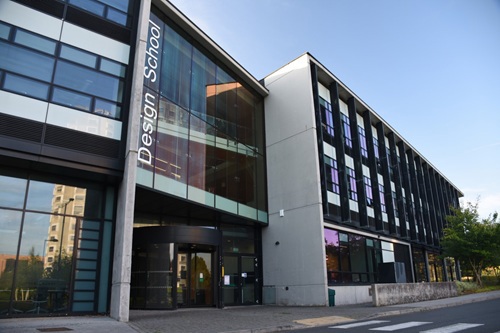 Transport Safety Research Centre is headquartered in Loughborough University's Design School. Photograph: Wikimedia
Autonomous vehicles – the next challenge
Under the Automated Vehicles Act 2024 (AVA 2024) we now have a comprehensive legal framework for self-driving vehicles in Britain.
This transition to autonomy comes with a sobering reality: a “safety dip,” says Andrew Morris, Professor of Human Factors in Transport Safety at the TSRC, who we sit down with separately after the seminar.
He explains that as mixed-use traffic – a combination of AVs and manual vehicles – becomes the norm, incident rates may initially rise. “Based on our modelling work we predicted there’ll be an increase in crashes,” he states.. “Simply because the two types of vehicles wouldn’t understand each other [at first] and the autonomous vehicle technology wouldn’t be mature enough to cope with the road situations that it would be confronted with.”
As the fleet matures, the tricky early transition period will give way to “huge” long-term safety improvements, he encourages. “It’s a classic predictable curve.”
Where we are in developing the safety rules
The implementation period of AVA 2024 is currently in a ‘high activity’ phase, as stakeholders and government work out what the detail should look like and what the secondary legislation will be.
Consultations on key areas including safety benchmarks for AVs, and questions on accessibility for older and disabled passengers on driverless taxis and buses, are currently live.
The TSRC, made up of a 25-strong multi-disciplinary team of specialists in human factors, crash investigations and psychologists, are among those submitting evidence into these consultations, helping to shape policy decisions and development of safety regulations.
We were able to see work being done in key areas of research in this regard. This included a study exploring how individuals respond to transition demands in automated vehicles and a recent project investigated the safety and accessibility needs of a diverse cohort of passengers during emergencies in driverless taxis (we will see trials of robotaxis in London from Spring). We also took part in collaborative ‘think tank’ sessions on real-world road user scenarios.
Situational awareness study on an AV simulator
TSRC has been exploring within its Human Factors laboratory how far engaging with hobbies or distractions while an AV is in self-driving mode, impact on a person’s capacity to safely take back control and drive. Specifically, a current two-phase study is looking at situational awareness using the AV driving simulator in the lab.
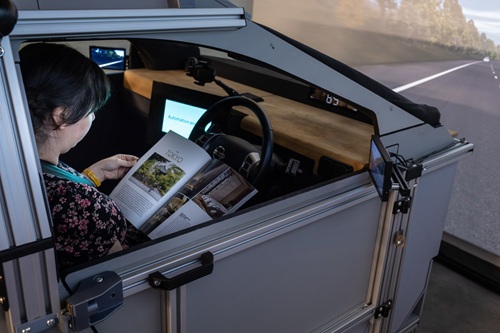 Participants were given activities to do such as reading and watching a movie to see how these might effect readiness to take back control of an AV. Photograph: TSRC
By way of background, under the AVA 2024, the User-in-Charge (UiC) of an AV must be ready to take control when a vehicle’s automated system issues a takeover request – there’s no legal time yet, but a 10-second system lead-time is a core proposal. “We gave people a series of non-driving related activities,” explains Professor Clare Mutzenich, who led the study.
“We had some that were just motor actions like eating and drinking. We had a couple that were more cognitive, doing a crossword or reading a magazine. And then we had two that were interacting with technology, so playing a game on your phone or watching a film on a phone.”
They also had tasks with no specific distractions where people could look around or stare out the window.
In the paper, a central finding was that almost all the 87 trial participants failed to check their mirrors before regaining manual control of the AV and before driving: “People would prioritise dropping the task and getting their hands on the wheel and taking over driving really quickly, but they didn’t look. It was a very consistent finding,” says Mutzenich.
With the ‘movie’ task “lots of people didn’t pause it. So, they were driving and still watching the film.”
Suggestions for future work is to study what impact there is on safe takeover behaviour if participants are given training on what a ‘good’ takeover of an AV looks like. This is obviously exciting, and important work, and shows the scope and need there is for training even experienced drivers: “It’s very much about the government being able to introduce secondary legislation into policy that is based on empirical data and on actual evidence,” says Mutzenich.
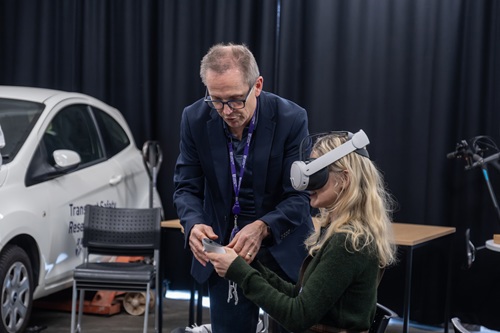 A Virtual Reality simulation study identified the necessary system interactions during emergency scenarios in a self-driving taxi to see how people of different age, gender, etc would respond. Photograph: TSRC
Hypothesised real-world road user conflicts
At the event, we also explored some future, hypothesised real-world road user conflicts as part of collaborative think tank sessions. Attendees worked through three structured scenario types, illustrated visually and, in some cases, using toy cars and figures as discussion aids.
Each scenario was used as a prompt to surface gaps, risks and opportunities together.
A standout session for us was a scenario in which an AV rolled into and injured a pedestrian crossing the road – the car behind had gone into the back of the AV. Although not given the information, our group posited that the car behind wasn’t expecting the AV to stop.
Professor Morris agrees that AVs may be more ‘conscientious’ about following the rules of the road and that this will be problematic. “In the US, where a lot of autonomous cars were overrepresented in crashes, it was simply because they were doing the right thing. They were stopping when they saw an amber light or any sort of pedestrian crossing. But the car following them wasn’t expecting that.”
Morris says that “almost certainly” we should consider training people driving for work in future to expect unexplained or sudden stops. Driving among and interacting with AVs before they become more common, could “in the short term, be very confusing.”
Vulnerable road users such as courier bikes could be more at risk: “There are all sorts of vulnerable road users that you can think of, and more are emerging almost every day. So micro and mobility scooters, cyclists, e-bikes, the preponderance of delivery riders. Those road users behave in very unpredictable ways. That’s where the real challenges are and where the autonomous vehicles will struggle, I think.”
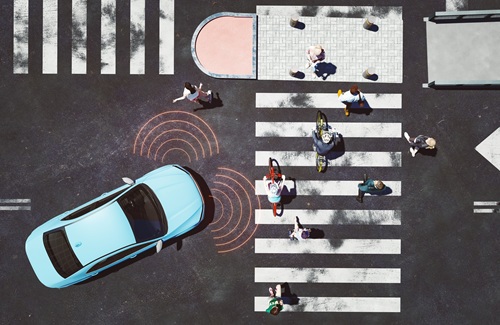 AVs may be more ‘conscientious’ about following the rules of the road, which may be confusing for other road users. Photograph: iStock/gremlin
Threats and opportunities
It’s a lot to take on board. The event highlighted there are myriad problems to iron out before widespread AV adoption.
On a basic level, informal communication that’s not written in the Highway Code, but which keeps us safe “will go”, says Professor Morris.
“My feeling is that all these things that we do, such as waving traffic on with your hand, or flashing your headlights, so that we can all cooperate on the roads and make the roads a nicer, safer place… they’re all going to go when autonomous cars become a reality,” he states.
How we will replace these informal, human bits of communication in the new technologies is “hard to envisage at the moment,” he shares openly.
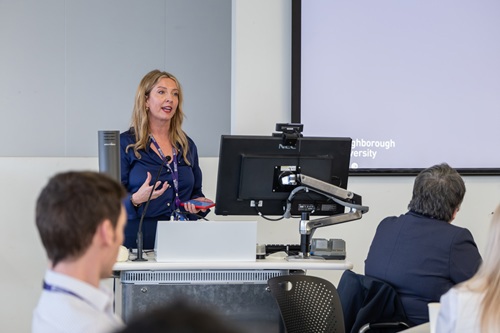 "We have an opportunity": Professor Clare Mutzenich, presenting at the seminar. Photograph: TSRC
But as Professors Mutzenich and Morris were both happy to voice, we have potentially amazing opportunities to improve safety and wellbeing for road users – including for employees who drive for work.
For example, driverless buses. (These have already been trialled in Cambridge and in London trials will remove the ‘safety driver’ which is not yet legal). If we remove the role of the bus driver, Mutzenich asks, it may still create an opportunity to provide different skills and jobs in the form of remote or on-board assistance on some services (to assist older passengers, for example).
“We could in this way get the benefits of automation in terms of consistency – being able to put bus routes on in places that demand wouldn’t normally make them viable. And if we use a human in a different way to provide the support that people are looking for from an accessibility point of view.”
We have an opportunity to make transport more accessible from the outset says Mutzenich: “We have over 16 million disabled people in the UK as well as the people they travel with. That’s a crazy amount of people to not include in [a market]. We’ve got the opportunity to make [transport] better.”
For long distance lorry drivers, being in driverless mode over long stretches of motorway could also be radical for drivers’ wellbeing and for solving fatigue, suggests Morris.
“In time, I think the benefits of autonomous vehicles for workers could be very huge. If the technology can be perfected where it’s safe and reliable to let the driver let the HGV or vehicle take the strain, then you can imagine how that would be in terms of rest and relaxation,” he says.
Conclusion
Increasing automation will happen over the next decade. Off road applications for AVs such as in warehouses and farming will probably come first and we will gradually see more driverless taxis and buses. “It will be more evolution rather than revolution. You’ll just see it more often,” says Mutzenich.
But the event was also an invitation to everyone in the system to shape the future. Following the day, the TSRC will be targeting partners across policy, operators and industry to co-design funded programmes and real-world trials based on the think tanks.
On a basic level, it was a chance to share information about what’s coming. “I think the more people that understand how things will change or can change when autonomous cars become the reality, the better,” says Morris.
Visit the Transport Safety Research Centre website here