The Indian Government’s Budget included much-trumpeted funding announcements for energy and carbon reduction projects like domestic solar panels and carbon capture, utilisation and storage technology, but campaigners were disappointed by the amount of money allocated for tackling dangerous levels of air pollution and adapting to climate change impacts.
Features
India’s Budget 2026–27: big on carbon capture, short on clean air funding
By
on 17 March 2026
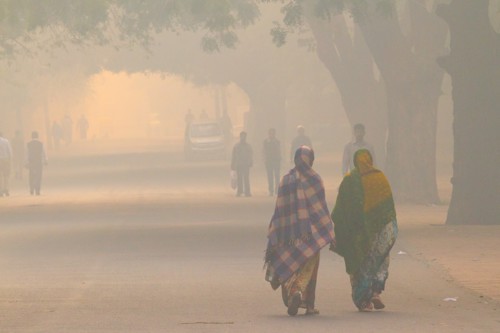
People in India breathe some of the world’s most toxic air, and air pollution is no longer a problem that solely affects the Delhi National Capital Region (Delhi–NCR). As cities across the country rapidly expand and industrialise, they are increasingly becoming hotspots for poor air quality. Nearly 44 per cent of Indian cities experience periods of chronic air pollution; however, only four per cent of them are covered by the National Clean Air Programme (NCAP), according to analysis by the Centre for Research on Energy and Clean Air (CREA). Launched in 2019, the NCAP aims to improve air quality in 131 cities across 24 states, all of which were chosen due to them experiencing poor air quality. Specifically, NCAP includes a target of reducing PM10 (inhalable particulate matter) pollution by 40 per cent compared to 2017 levels.
The health and economic costs of air pollution are staggering. Air pollution reduces the average life expectancy in India by 3.5 years, and is estimated to cost India around six per cent of its GDP, primarily due to health risks and productivity losses. The World Bank says 1.67 million deaths were attributable to air pollution in India in 2019, and adds the country incurs substantial economic losses due to premature deaths and morbidity caused or associated with air pollution.
Indeed, former International Monetary Fund (IMF) economist Gita Gopinath argues that air pollution is currently the biggest challenge to India’s economy, far surpassing the threat of global tariffs from countries like the United States.
Brutal consequences of a warming planet
Meanwhile, climate change impacts are intensifying, with India facing the brutal consequences of a warming planet, such as higher temperatures, longer heatwaves and more intense monsoon rainfall. According to the Indian Meteorological Department’s annual climate statement, India experienced its eighth warmest year on record in 2025. Another study has warned that India is likely to have one of the largest populations exposed to extreme heat as global temperatures continue to rise.
In 2025, the climate crisis led to a wild and torrential monsoon, with large parts of the country reeling under flooding after torrential downpours. Punjab experienced its worst rainfall deluge in decades, with flooding affecting around 400,000 people and 2,000 villages, causing 51 deaths, and resulting in an estimated financial loss of over Rs. 13,000 crore.
According to the annual Climate India 2025 assessment by Delhi-based sustainability think tank the Centre for Science and Environment (CSE) and Down To Earth magazine, India faced extreme weather events on 99 per cent of days in the first nine months of 2025, marked by heatwaves and spells of cold weather, lightning, storms, heavy rain, floods and landslides. These events claimed 4,064 lives, affected 9.47 million hectares of crops, destroyed 99,533 houses and killed approximately 58,982 animals, according to CSE and Down to Earth.
“Heavy rain, floods and landslides were the deadliest, accounting for 2,440 deaths, followed by lightning and storms (1,456), cloudbursts (135), heatwaves (21) and snowfall (12), between January and September 2025,” says the assessment.
The assessment noted that the year 2025 broke several climate records. January was India’s fifth driest since 1901, while February became the warmest in 124 years. In September, India recorded its seventh-highest mean temperature for the month, with the minimum temperature ranking as the fifth highest on record.
Funding for climate adaptation
Against this backdrop, climate experts were hopeful that the Union Budget for 2026-27, delivered on 1 February, would include funding and measures for climate adaptation. Hopes for such funding had risen after the Economic Survey 2025-26 tabled in Parliament on 29 January by Union Minister for Finance and Corporate Affairs Nirmala Sitharaman highlighted the lack of available finance for climate adaptation measures, especially from international and private sources.
So, did the Finance Minister’s ninth straight Budget put environmental protection and climate action at the forefront at a time when India faces a cascade of environmental crises, including relentless heatwaves, urban flooding, stronger cyclones and prolonged spells of hazardous air quality?
Well, the answer is yes to an extent.
The budgetary allocation to the Ministry of New and Renewable Energy, the government department responsible for developing and deploying new and renewable energy to supplement India’s energy requirements, rose to a record high of ₹32,914 crore, with ₹22,000 crore allocated to the flagship solar energy scheme PM Suryaghar Yojana, which provides subsidies to households to install rooftop solar panels.
Alongside exemptions on customs duties for imported materials to be used for lithium-ion and electric vehicle battery manufacturing, Viability Gap Funding (VGF) for Battery Energy Storage Systems (BESS), and grants to encourage the development of carbon capture, utilisation and storage (CCUS) technologies, the Government appears intent on building an energy system that cuts greenhouse gas emissions, reduces reliance on fossil fuels and expands the use of renewable energy.
Air quality
However, when it comes to improving air quality across the country, commentators argue the Budget was much less ambitious.
Finance Minister Nirmala Sitharaman earmarked Rs 1,091 crore funding for local pollution control boards and the NCAP. However, this figure is actually Rs 209 crore less than the revised estimate of Rs 1,300 crore that was allocated in the previous year, 2025–26. Notably, the original allocation for pollution control in 2025–26 was only Rs 853.9 crore, although the sum was later increased.
Experts argue that the timing of the funding cut for air quality measures is deeply disappointing. Delhi–NCR and neighbouring regions continue to record hazardous air quality levels, leading to school closures, health warnings reminding people to avoid exposure to poor air quality where possible and increased numbers of respiratory illnesses. Despite this, the budget did not provide additional funding to strengthen pollution control efforts, say air quality campaigners.
In a post on social media, senior sustainability scientist at Princeton University, Dr Ajay S Nagpure, pointed to a deeper structural issue: utilisation of government funding for pollution control. In the financial year 2024–25, the Union Budget allocated Rs 858 crore under the ‘Control of Pollution’ section of the Ministry of Environment, Forest and Climate Change, but actual expenditure was only about Rs 16 crore – roughly 1–2 per cent utilisation of the allocated funding. Under the NCAP, utilisation has also been uneven; Delhi has reportedly used just Rs 14.1 crore, around 14 per cent, of the Rs 99.77 crore funding provided since 2019.
“The issue is not merely budget size – it is execution,” Dr Nagpure wrote. “Unless institutional capacity to deploy and monitor funds improves, India risks repeating another decade of policy announcements without commensurate improvements in urban air quality outcomes.”
Critics also note the continued emphasis on coal, nuclear energy and carbon capture technologies (CCUS), the last of which aims to capture carbon dioxide (CO2) emissions from industrial sources for permanent underground storage or reuse in products like synthetic fuels, chemicals and building materials. During a panel discussion organised by the Impact and Policy Research Institute (IMPRI), a think tank for policy research, Ashish Kothari, environmentalist and founder of the non-profit environmental action group Kalpavriksh, said that air pollution and the environment were not explicitly mentioned in the Finance Minister’s Budget speech. In contrast, large sums were being channelled towards coal, nuclear power and carbon capture technologies, he pointed out, according to a report in The Indian Express.
Vibhuti Garg, director for South Asia at the Institute for Energy Economics and Financial Analysis (IEEFA), stated: “The Rs 3,500 crore allocation for coal and lignite gasification, alongside a proposed Rs 20,000 crore outlay over five years for CCUS, would benefit from careful assessment against cost-effectiveness and deployment timelines. While innovation across technologies is important, these solutions remain capital-intensive and technologically uncertain, particularly when compared to the falling costs and proven scalability of renewables, storage and electrification.”
He added: “Budget 2026 reflects strong macro-fiscal ambition. Additional emphasis on grid infrastructure, energy storage, transport electrification and risk-mitigation mechanisms could further accelerate India’s energy transition while strengthening climate, air quality and energy security outcomes.”
Climate change adaptation measures
Other sustainability and climate experts argue that climate change adaptation measures remain under-prioritised. Abinash Mohanty, global sector head, climate change and sustainability, at international consultancy group IPE Global, said: “The Budget reflects continuity and intent in India’s energy transition, anchored by measurable investments in clean energy deployment and industrial decarbonisation… the Budget’s emphasis on grid modernisation and inter-state transmission infrastructure is both timely and essential to ensure system reliability, flexibility, and optimal utilisation of clean power assets.”
Mohanty believes that on their own, climate mitigation measures, such as restoring wetlands to absorb increased rainfall and updating buildings with features like green roofs to better withstand high temperatures, cannot address India’s climate challenges. He adds that without quantified targets, dedicated financing and institutional focus on resilience-building, the transition to clean and renewable energy risks becoming uneven and exclusionary. “Future budgets must therefore align India’s clean energy ambition with equally robust, evidence-based investments in climate resilience.”
In a post on X, Uttarakhand-based social and environmental activist Anoop Nautiyal said: “The Union Budget 2026–27 offers no specific allocation or policy framework for Uttarakhand or the Indian Himalayan Region. Support remains indirect, ignoring the region’s unique climate, ecological and disaster risks. The absence of provisions for floating population, green bonus or mountain-specific risk frameworks highlights the urgent need for Himalayan states to unite around a collective, common agenda.”
For climate and sustainability experts, it is no longer a question of whether India is investing in clean energy but whether those investments are in sync with the scale and immediacy of the environmental crises unfolding across the country.