
Pesticides are widely used in India to control pests that damage vital food crops, but with widespread reporting of pesticide poisoning and other health damage among farm workers, campaigners say the country needs to move to more ecological methods of pest control.
Features
The human cost of pesticides in Indian farming
By
on 17 April 2026
For years, Milind Nawale worked with pesticides on a cotton farm in Maharashtra state – from filling spray tanks to mixing and spraying the chemicals. “I sprayed the pesticides with my bare hands, carrying the heavy container on my back,” he recalls.
Working without a mask or gloves, Nawale used pesticides to eliminate pests such as mealybugs and aphids that attacked his cotton crop, grown on five acres of land in Jalgaon district of Maharashtra. During the four month-long growing season, he sprayed pesticides up to three times. “Over time, many pesticides lose their effectiveness as pests develop resistance, which lowers their field performance. That is why I had to spray multiple times for a high yield,” he says.
Due to his financial circumstances, Nawale was refused bank loans and was often forced to turn to moneylenders to buy seeds, fertilisers and pesticides. “They lend money instantly, but at exorbitant rates of interest,” he said. “I bet my land and my life on a better yield, so in no way am I going to let pests ruin it all.”
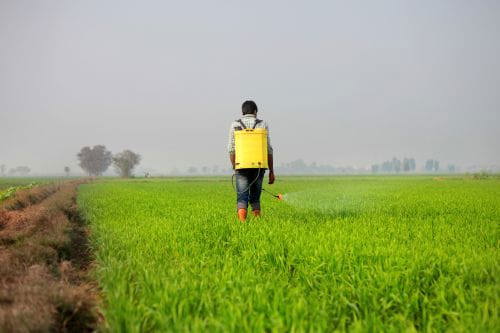
Nawale recalls how exposure to chemical fumes while mixing and spraying pesticides caused persistent coughing, meant the smell of chemicals lingered on his clothes, and even affected the taste of the food he prepared afterwards.
A few years ago, Nawale was diagnosed with pulmonary fibrosis, a chronic, progressive lung disease, which makes it difficult to breathe and reduces the lungs’ capacity to transfer oxygen into the bloodstream. “When my chronic cough, wheezing, and shortness of breath continued for months, I consulted a doctor at a government hospital and was told of my condition,” he says.
Nawale was unaware of the health risks associated with pesticide exposure, and had relied heavily on pesticide spraying to protect his crops. “I did not know I was doing it at the cost of my health,” he admits. He still sprays pesticides but now wears gloves, masks, goggles and protective clothing in a bid to reduce the exposure risks.
Decades of exposure
In the paddy fields of Purulia, West Bengal, Krishna Burman’s experience echoes Nawale’s.
“I was only 14 or 15 when I began working on our family farm,” says the 57-year-old, who spent decades mixing and spraying pesticides with his bare hands.
Farm work was entirely manual – from ploughing and harrowing to planting seedlings in neat rows in waterlogged fields and harvesting the rice stalks in scorching heat. Pest attacks were frequent, particularly from the paddy stem borer, which can cause yield losses ranging from 10 to 80 per cent.
“To protect our crops, I handled spraying,” recalls Krishna. “My elder brother bought pesticides from local merchants, who were also our main source of information [about how to use them]. I would mix them with my hands and spray.”
More than 40 years later, Burman has stopped spraying pesticides after developing severe skin rashes. “This was bound to happen. I often had painful skin irritation, but ignored it. The hot and humid weather here increases pesticide absorption through sweating,” he says.
He believes prolonged exposure and overuse of pesticides forced him out of farming. “Now my brother and our sons manage the farm,” he says.
Luckily, Burman subsequently found a job in a rice mill nearby, and his family is relieved that he no longer has to work on the farm every day.
“I needed a way out of farming,” he explains. “I could not bear the pain from the rashes, along with unpredictable weather, high input costs, poor pest management and market fluctuations.”
Nawale and Burman were fortunate to avoid the gravest consequences of pesticide poisoning, but many others, such as Ganesh Katre, a young farmer from Maharashtra, were not so lucky.
When exposure turns fatal
In September 2025, 22-year-old Ganesh Katre died of pesticide poisoning at the Government Medical College and Hospital in Akola, in the Vidarbha region of Maharashtra, according to a report by The Times of India.
According to the news report, Ganesh suffered poisoning while spraying pesticide on crops at his family’s farm at a village near Daryapur in the Amravati district of Maharashtra. Although doctors fought to save him, he dies four days after being admitted to hospital. The Times of India reported that Ganesh’s death was not an isolated incident, with the hospital treating up to 170 cases of pesticide poisoning among farmers and farm workers in the five-month period between June and October 2025. The patients reportedly complained of symptoms like eye irritation, nausea, vomiting and restlessness.
Ganesh’s death revived memories of the 2017 Yavatmal tragedy, when hundreds of agricultural workers across Vidarbha in Maharashtra fell ill after spraying pesticides on cotton fields. According to media reports, at least 23 died.
Many had used Polo, a pesticide produced by Syngenta, a Switzerland-based agrochemical company. Although the pesticide was banned in Switzerland in 2009 due to its harmful effects, it continued to be exported to countries like India.
Syngenta denied responsibility, stating there was no evidence linking Polo to the deaths in Vidarbha. However, the European Chemicals Agency classifies Diafenthiuron, one of the active ingredients in Polo, as “poisonous when inhaled” and warns it “may cause damage to organs through prolonged or repeated exposure”.
A 2025 investigation by Public Eye, a Swiss-based campaign group that analyses the impact that Switzerland, and its companies, has on poorer countries, and Unearthed, an investigative journalism project funded by Greenpeace UK, found that the European Union exported nearly 122,000 tonnes of banned pesticides in 2024, largely to low- and middle-income countries. “Swiss agrochemical giant Syngenta plays a leading role in this toxic trade,” the report noted.
A widespread health crisis
Research published in the peer-reviewed journal BMC Public Health estimates that globally, 385 million agricultural workers fall ill each year due to pesticide poisoning. Symptoms range from headaches, vomiting and diarrhoea to skin disorders, neurological problems and unconsciousness. In severe cases, vital organs, such as the heart, lungs or kidneys, may be damaged. Around 11,000 deaths occur annually due to pesticide poisoning, according to the study published by BMC Public Health, although this figure excludes suicides linked to pesticide exposure.
Studies also suggest that farmers often prioritise immediate crop protection over the long-term environmental and health risks from using pesticides – an approach reflected in Nawale’s experience.
Respiratory and skin disorders
According to research, some of the most common health effects of pesticide exposure are respiratory and dermatological conditions that affect the wellbeing of agricultural workers.
Frequent inhalation of pesticide residues can lead to chronic coughing, wheezing, breathlessness, asthma and chronic obstructive pulmonary disease (COPD). Prolonged exposure can cause inflammation of the airways, lung damage and impaired respiratory function. Common pesticide groups, such as organophosphates, carbamates and pyrethroids, are known to have neurotoxic and pulmonary effects.
Skin-related conditions are equally widespread. Direct exposure can cause dermatitis, rashes, hyperpigmentation and eczema. Many workers handle, use and spray pesticides without wearing suitable protective clothing, gloves, goggles or masks, leading to repeated absorption of toxic chemicals. Over time, this can result in skin burns, allergic reactions and, in extreme cases, long-term skin conditions such as skin cancer.
Small-scale farmers – who manage about 99 per cent of the world’s farms and produce 60 per cent of global food – are particularly vulnerable, says campaigners. In many rural areas, lack of awareness, training and protective equipment makes pesticide exposure a persistent risk.
Gaps in regulation
In India, the pesticide use is subject to restrictions set out in the Insecticides Act, 1968, and its associated rules, which are over 50 years old.
To modernise the framework, the Ministry of Agriculture and Farmers’ Welfare has proposed a Pesticides Management Bill. However, activists argue that it fails to adequately address long-standing concerns related to the health, safety and environmental impacts of pesticide use.
According to analysis of the bill by Dr Narasimha Reddy Donthi, a policy expert at Pesticide Action Network (PAN) India, the bill has a number of crucial deficiencies, including a weak institutional hierarchy, a lack of traceability, an absence of health surveillance for cases of pesticide poisoning, vague definitions, excessive executive discretion, inadequate criminal liability and insufficient protections for workers.
A ‘toxic harvest’ and the way forward
“The current agricultural crisis in India is a profound reminder that our pursuit of food security has come at a staggering cost to natural resources and public health,” says Krishna Kumar, an environment and natural resource management and climate change expert.
“For millennia, Indian agriculture was rooted in organic systems. This changed during the Green Revolution, which introduced chemical-intensive farming. Decades later, we are witnessing what I describe as a ‘toxic harvest’.”
Kumar adds that pesticide use is already a major occupational hazard in India’s agricultural sector, with nearly 40 per cent of farm workers suffering from skin lesions linked to chemical handling.
“More insidiously, fertiliser run-off into groundwater has been linked to increased neonatal mortality and stunting in rural areas’” he added. “Punjab’s ‘Cancer Train’ [a nightly train that departs Bathinda, Punjab, for Bikaner, Rajasthan, carrying cancer patients seeking affordable treatment] is a stark reminder of this crisis.”
Kumar also highlights geopolitical risks: “India’s dependence on fertiliser imports from West Asia has created vulnerabilities. Disruptions in liquefied natural gas supply, a key input for urea, have increased costs and placed pressure on subsidies.”
Urea production has reportedly declined to 18 lakh tonnes in March from an earlier average of 24 lakh tonnes, according to The Times of India.
“The way forward requires a shift to resource-efficient farming,” argues Kumar. “While initiatives such as PM-PRANAM and nano-fertilisers are steps in that direction, the ‘Sikkim model’ of 100 per cent organic farming offers a long-term pathway.
“Restoring soil health is not just an agricultural necessity – it is a critical public health and national development priority if India is to become a developed nation by 2047,” he added.
Commentators argue that the best way to prevent agricultural workers being exposed to pesticides – and prevent pesticides from contaminating land and waterways and causing toxic pollution of species like fish and pollinators like bees – is to eliminate or substitute them with less harmful alternatives.
They say that ‘agroecological’ practices – sustainable farming methods that enhance biodiversity, soil health and ecosystem services by mimicking natural processes, such as simultaneously planting several crops to break pest cycles, and growing aromatic plants to manage pests rather than relying on chemicals – can help to control pests that damage crops, eliminating or reducing the need for pesticides altogether. Another example is using pheromone traps, which lure insects with a fragrance that mimics mating signs. This traps the insects on a sticky surface or inside a container, helping manage pests without harming the environment.

FEATURES

Fatal falls in India: why are the numbers not declining?
By Orchie Bandyopadhyay on 17 September 2026
Despite widespread awareness of safe working procedures and equipment, falls from hieght remain one of the leading causes of workplace death and serious injury in India. Critics say problems such as time pressures and inadequate training lie at the root of many of these incidents, but others are hopeful that the new Occupational Safety, Health and Working Conditions Code will herald a reduction in falls by driving improvements in training, competence and supervision more widely.

Avoidable deaths, endless excuses: how can India improve its workplace safety culture?
By Orchie Bandyopadhyay on 17 September 2026
A recent series of high-profile workplace tragedies that claimed multiple lives across India have stoked public debate about the poor safety record of many of the country’s highest-risk industries. Trade unions argue that greater enforcement of safety laws is required to change business behaviour, while other commentators say many businesses require a huge internal cultural shift to safety excellence that must be led by directors and senior managers.
Why contact with electricity is this year’s leading powered access safety challenge
By on 14 September 2026