
Railway maintenance in India is a dangerous and difficult task, with track workers facing a high risk of being struck by trains and challenging working conditions, such as punishing summer temperatures. The government has promised improvements to working conditions, but trade unions argue the pace of change must be drastically increased to make the work safer and more bearable.
Features
India’s railway trackmen – walking the line of hidden dangers
By
on 19 November 2026
The course of history changed in India 173 years ago in 1853, when the first passenger train rolled from Bombay to Thane. In the years that followed, steam engines gave way to diesel locomotives, and many of these have gradually been replaced by electric trains that are faster, cleaner and more efficient, connecting multiple cities, towns and villages.
Although transport modes have changed over the years, with the invention of aeroplanes and the expansion of the national highway network, the vast network of railways remain a crucial part of India’s transport infrastructure, allowing quick movement of people and goods across states and union territories.
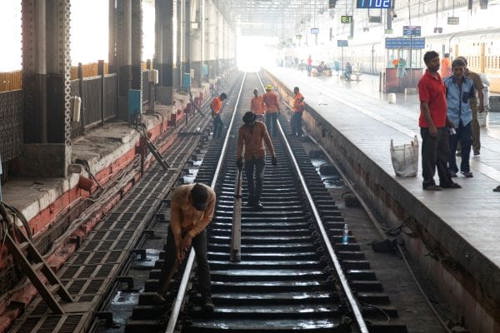
In 2025–26, India’s railways carried 7.41 billion passengers, while total freight movement reached a record 1,670 million tonnes. Today, more than 1.1 million people are employed by the rail industry, working on trains, at stations, in railyards, and across other various operations of the world’s fourth-largest railway network.
Recently, ahead of the festive season, the Modi government approved a productivity-linked bonus equivalent to 78 days’ wages for around 1.14 million railway employees, with each eligible employee set to receive a maximum of Rs 17,951 in recognition of their dedicated service and performance. The bonus will benefit various categories of railway staff, including track maintenance workers, locomotive pilots (drivers), train managers (guards), station masters, supervisors, technicians, and signal and points control staff.
Risky activity
However, working on the railways remains a risky activity, and a number of inherent dangers remain, despite advances in safety. The risks include track workers being struck by moving trains and maintenance workers suffering electrical shock incidents when working on lineside and station electrical equipment. In fact, India’s railroad workers continue to suffer serious injuries, including amputation injuries, and some of these incidents are very common.
So, how risky is working on the railways – for example, as a track maintenance worker?
In 2023, the Ministry of Railways informed Parliament that more than 360 railway workers had lost their lives in the previous five years while carrying out maintenance work on train tracks.
And fatal incidents to railway maintenance and other workers continue to occur to this day. For instance, in July 2026, a railway gangman named Joy Gopal Sarkar died after being struck by a goods train while carrying out track maintenance work near Falakata railway station in the Alipurduar district of West Bengal. The 48-year-old, who lived in Assam, was employed by the Northeast Frontier Railway.
Meanwhile, in August, a junior engineer employed by Indian Railways died after being struck by a train while on duty in Agra, Uttar Pradesh. According to The Times of India, the worker, named Manoj Sain, had stepped off a track maintenance machine and was then stuck by an express train. Both his legs were severed in the accident, but despite severe blood loss and blurred vision, the 32-year-old remained conscious and managed to call a fellow engineer for help. His colleague in turn alerted police, who rushed to the scene and transferred him to the Community Health Centre (CHC) in Saiyan for treatment, reported The Times of India. He was subsequently transferred to SN Hospital, but died at around 7pm the same day.
In October, a 58-year-old railway gangman named K Gobind Patra died after being struck by the Bhubaneswar-Visakhapatnam inter-state express train while carrying out track maintenance work in Odisha’s Ganjam district.
In another incident in the same month, two railway track workers were killed and two others were injured after the Goa Express struck an engineering trolley near Maksi station in Madhya Pradesh.
As well as the risk of being struck by trains or injured in electrical incidents, track workers may be exposed to other risks unrelated to their jobs. For instance, in August 2025, a railway trackman was killed and another injured after an improvised explosive device planted by Maoist operatives detonated on the railway tracks near Renjda station in Odisha’s Sundargarh district.
Unsung heroes
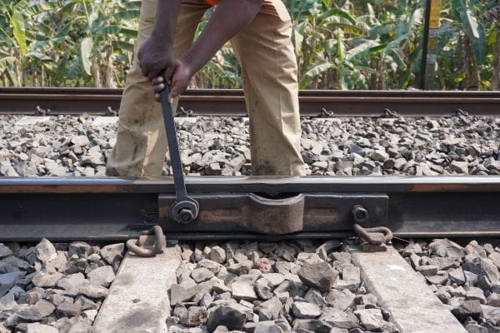
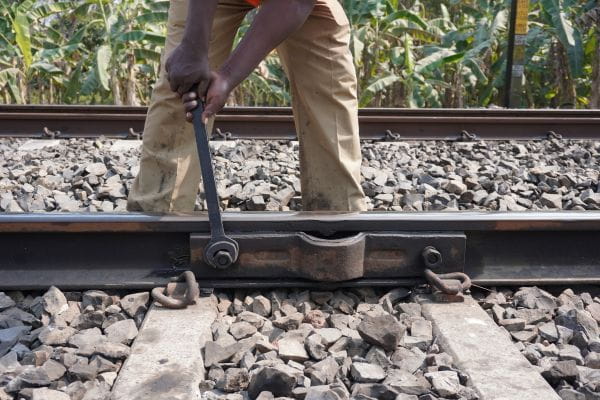
Known as the ‘Orange Army’ due to their high-visibility orange safety vests and uniforms, the 'track maintainers’ employed by Indian Railways cover countless kilometres every day on foot, walking the tracks through hot summers and relentless monsoons, looking for track defects, which they then report for repair.
Also known as trackmen, gangmen or keymen, these workers – who are almost exclusively male – are responsible for ensuring the tracks are safe and fit for the movement of hundreds of trains.
These unsung heroes help ensure that millions of rail passengers can travel safely every day, but they are often required to work in high risk and unsafe locations.
Describing his daily routine, Rakesh Chandra Verma, a trackman, told news website ETV Bharat that he walks 15–16km a day while on foot patrol duty inspecting tracks and other rail infrastructure. Carrying a toolkit weighing around 18kg on his back and wearing heavy safety boots, makes the long-distance patrols even more physically demanding, he said.
The hardship becomes particularly acute during the extreme heat of June and July. Walking more than 15km in high temperatures under strong sunlight while carrying a heavy toolkit and wearing heavy safety boots is physically demanding, Verma said.
“The Railways has a norm limiting a trackman’s patrolling duty to 12km, but this is often violated,” Verma said.
Lengthy patrolling beats
Earlier this year, Aam Aadmi Party MP Sanjay Singh urged railways minister Ashwini Vaishnaw to restrict the daily patrolling beat of railway track maintainers to 12km, and called for them to be granted various other benefits to help support their safety and wellbeing. “The maximum patrolling beat for keymen and patrolmen should be restricted to 12km, keeping in view physical limitations and safety concerns,” Singh said in a recent letter addressed to Vaishnaw, according to a report by Press Trust of India.
Referring to a list of 10 demands raised by the All India Railway Trackmaintainer Union (AIRTU) for the North Eastern Railway region, he urged the Union government’s railway minister to show empathy over the difficult working conditions of track maintainers and to take appropriate measures to improve their safety and wellbeing.
“The four-member committee constituted by the Ministry of Railways (Railway Board) on 29 November 2024 to examine issues relating to promotion and career progression of Track Maintainers was required to submit its report within eight weeks,” said Singh. “However… the report has not been made public. This report, which concerns the future of lakhs of track maintainers, should be published immediately.”
The AAP MP added: “The practice of initiating harsh disciplinary action, including dismissal under Section 14(2) for minor or unintentional errors, should be discontinued, and disproportionate financial penalties should be avoided.” Singh added that addressing these long-standing worker grievances would not only boost the morale of track maintainers but also enhance railway safety and operational efficiency.
Staff shortages
The poor working conditions track maintainers are forced to endure are compounded by staff shortages, say rail worker unions. “Thousands of vacancies for track maintainers remain unfilled across Indian Railways, resulting in an excessive workload for existing staff,” said a member of the All India Railway Trackmaintainer Union. “They [track maintainers] are often denied holidays, adversely affecting their mental health. They get winter uniforms when winter is over. The Railway Ministry doesn’t realise how laxity on its part makes trackmen’s lives so difficult and challenging.”
The trade union member added: “The government keeps failing in its promise to provide them [track maintainers] with proper facilities. Outdated practices dating back to the British era continue to govern railway operations, making working conditions particularly difficult for gangmen.”
At a conference for track maintainers, organised by the All India Railwaymen’s Federation in Delhi on 22 April, a brief interaction with the railway minister exposed the gap between official claims about working conditions and the reality faced by workers on the ground, according to a report by The Times of India.
Railways minister Ashwini Vaishnaw reportedly asked track maintainers present how many of them were provided with “lightweight tools”, and the response was “dismal”. Vaishnaw reportedly responded: “This is wrong. There is a sharp gap between your (official) reporting [by Indian Railways] and the reporting from people here [track maintainers]. In how many months will you [Indian Railways] achieve the target of providing lightweight tools to all?... in six months, you all, across the country will get them, and in 6-8 months you will also get gauge measuring tools.”
According to The Times of India, Vaishna added that ensuring the safety of passengers and the railway workforce remains the government’s “prime focus”, and promised there would be a “complete modernisation” of track maintenance over the next 7-8 years. The minister added that, for instance, track workers will soon be supplied with torque machines to replace heavyweight hammers, avoiding the need to carry these heavy items while working along tracks to carry out maintenance.
The Times of India reported that Vaishnaw added that Indian Railways has developed a mobile app which updates and alerts track workers about approaching trains to prevent accidents. He said that provides these alerts through the mobile phone network would be more reliable than using VHF-based communications devices. The app is undergoing tested for around 18 months and will then be made available to everyone working on the tracks, reported The Times of India.
Urgent need for improvements
Shiv Gopal Mishra, secretary general of the All India Railwaymen’s Federation (AIRF), described the trackmen as the “lifeline” of Indian Railways and emphasised the urgent need for improvements to ensure the safety and wellbeing of staff carrying out some of the industry’s most hazardous tasks.
“More than 2.5 lakh trackmen form the lifeline of Indian Railways and play a crucial role in maintaining its 60,000 km of railway tracks,” he said. “It is also one of the most dangerous jobs. We constantly strive to improve their working conditions, but much remains to be done. This conference has two main objectives: first, to ensure that railway operations are safe; and second, to ensure that trackmen are well taken care of,” Mishra told ANI (Asian News International).
FEATURES
India’s railway trackmen – walking the line of hidden dangers
By Orchie Bandyopadhyay on 19 November 2026
Railway maintenance in India is a dangerous and difficult task, with track workers facing a high risk of being struck by trains and challenging working conditions, such as punishing summer temperatures. The government has promised improvements to working conditions, but trade unions argue the pace of change must be drastically increased to make the work safer and more bearable.
Reducing lithium-ion battery fire risk in warehouses: new guidance points the way
By on 16 November 2026