
When disasters strike, they expose more than immediate failures – they reveal the gaps in how we protect people. In the UK, some of the most significant advances in public safety have followed tragedy, forcing a re-evaluation of how buildings are designed, managed and evacuated. Yet as expectations evolve and legislation tightens, a critical question remains: are we truly prepared to ensure everyone can evacuate safely in an emergency?
Features
When disasters drive change: why inclusive evacuation can no longer be an afterthought
By
on 19 May 2026
In the UK, major advances in public safety have often followed tragedy. From terrorist attacks to catastrophic fires, large-scale incidents have repeatedly exposed loopholes in the systems designed to protect people inside buildings.
While these events have prompted regulatory reform and heightened expectations of those responsible for safety, turning lessons into lasting improvements has often proved slow and complex. The key question remains: has emergency planning evolved enough to ensure everyone can evacuate safely?
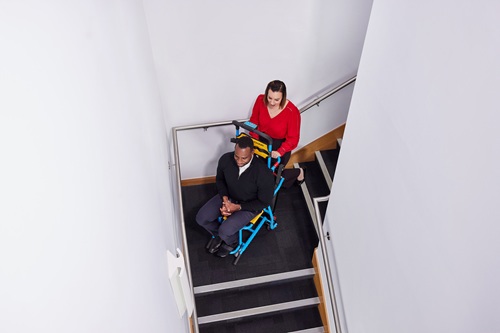 Photograph: Evac Chair
Tragedy as a catalyst for reform
In May 2017, a terrorist attack at Manchester Arena following an Ariana Grande concert killed 22 people and injured hundreds more, exposing serious vulnerabilities in how publicly accessible venues plan for, assess and manage risk.
The UK’s terrorism threat level has remained at ‘substantial’ for several years, meaning that an attack is likely. Since 2017, security services have intercepted 43 late-stage attack plots, while around 15 terrorist attacks have taken place in the UK. Counter Terrorism Policing continues to make hundreds of terrorism-related arrests each year, underscoring the persistent nature of the threat facing publicly accessible spaces.
Following the Manchester Arena attack, the subsequent campaign led by Figen Murray OBE, the mother of one of the victims, Martyn Hett, resulted in the introduction of Martyn’s Law – formally the Terrorism (Protection of Premises) Act 2025 – which received Royal Assent in April 2025.
The legislation places a statutory duty on those responsible for publicly accessible premises to assess terrorism risk and implement proportionate protective measures.
Venues are tiered according to capacity, ensuring that requirements scale appropriately. Crucially, the Act embeds risk assessment, emergency planning and staff training into operational responsibility. Full implementation for those who fall into the tiers is required by April 2027, reinforcing the principle that preparedness must be demonstrable.
In the same year as the Manchester Arena attack, the Grenfell Tower fire exposed systemic failings in building safety and evacuation strategies. The tragedy claimed 72 lives, including 15 residents with mobility impairments. The ‘stay put’ policy, reliant on effective compartmentation and fire-resistant construction, suppression and up-to-date fire risk assessments, proved catastrophic when those systems failed.
The central lesson was clear: evacuation models dependent on multiple safeguards are vulnerable if any one element collapses.
Nearly a decade on, concerns around high-rise residential evacuation remain. Following consultation, the Government introduced the Fire Safety (Residential Evacuation Plans) (England) Regulations 2025, which came into force on 6 April 2026.
These require responsible persons to identify residents in high-rise residential buildings who may struggle to self-evacuate and offer a Person-Centred Fire Risk Assessment (PCFRA) to inform appropriate evacuation arrangements.
Other sectors have faced similar scrutiny. In 2017, a fire at Newgrange Care Home in Hertfordshire led to two fatalities and significant fines for fire safety breaches, highlighting failures in compartmentation and evacuation preparedness.
Even where fatalities have been avoided, expectations are shifting. When wheelchair user Lucas Vezza-O’Brien was unable to evacuate during a school fire in Manchester, he was instructed to wait in a refuge area while other students evacuated due to a lack of evacuation equipment. This prompted the #NoStudentLeftBehind campaign and triggered parliamentary debate about the preparedness of schools and colleges.
Too often, evacuation procedures are designed around the needs of the majority, rather than the realities of a diverse population.
From reactive response to anticipatory responsibility
Responsibility is increasingly framed around planning and anticipation rather than response. However, effective anticipation requires a clear understanding of who may be at risk during an evacuation – and what support they may need.
In 2024, around 16.8 million people in the UK were living with a disability – nearly a quarter of the population. More than 5.5 million are in employment, and with more people working beyond traditional retirement age, organisations must plan for a more diverse workforce.
Around 80% of disabilities are invisible, including chronic health conditions, cognitive impairments and temporary mobility restrictions.
These figures challenge traditional assumptions about who may require assistance in an emergency.
Mobility impairment is not confined to permanent wheelchair users; it can include individuals recovering from surgery, those in late-stage pregnancy, people whose conditions fluctuate or individuals experiencing cognitive or mental health challenges that may affect their ability to respond quickly in an emergency.
As workplaces, residential and public spaces become more inclusive in everyday use, emergency planning must reflect the same level of consideration.
Accessibility is only half the story
Significant progress has been made in improving accessibility across buildings and public spaces, with ramps, lifts, widened doorways and accessible facilities now widely expected. Yet while the focus has been on helping people enter buildings, far less consideration has been given to whether everyone can safely evacuate them in an emergency.
In most multi-storey buildings, staircases remain the primary means of escape. When lifts are unavailable during a fire, individuals with mobility impairments are therefore dependent on assistance – or left waiting.
The Grenfell Inquiry highlighted the risks of relying on a single evacuation strategy. The ‘stay put’ approach can be effective when compartmentation, alarms and suppression systems work as intended and fire remains contained. When these safeguards fail, evacuation quickly becomes urgent and complex, particularly for those unable to leave independently.
Embedding inclusive preparedness
Legislation provides the framework for safety, but preparedness depends on implementation. Effective evacuation planning requires alignment between equipment, training and maintenance.
Evacuation equipment should suit the building’s layout and accommodate the diverse mobility needs of its occupants. In publicly accessible and multi-storey premises, this often requires adaptable solutions for a range of evacuation scenarios.
Manufacturers specialising in evacuation solutions are increasingly designing equipment to accommodate a wider range of mobility needs and payloads, supported by structured training and servicing to ensure readiness. As the original manufacturer, with more than 40 years of experience, Evac+Chair proudly manufactures its evacuation chairs in the UK and emphasises that inclusive evacuation is about far more than simply installing equipment.
However, equipment alone cannot ensure safety. In high-pressure environments, confidence and competence are critical. Staff must understand how to deploy chairs correctly and safely, maintaining composure while supporting individuals who may already be vulnerable or distressed.
Maintenance is equally essential. As Class I medical devices, Evac+Chairs must be inspected and serviced annually in accordance with the UK’s Provision and Use of Work Equipment Regulations 1998 (PUWER). Failure to maintain equipment introduces avoidable risk and may expose organisations to compliance failures under workplace safety regulations.
An effective evacuation strategy therefore rests on three interdependent elements: appropriate equipment, trained personnel and ongoing servicing. Together, these provide demonstrable evidence of preparedness.
Learning before the next crisis
Each major disaster that has shaped reform was preceded by identifiable vulnerabilities. The introduction of Martyn’s Law and RPEEPs marks important progress, but legislation alone cannot eliminate risk.
Expectations placed on organisations have evolved. Responsible persons must anticipate foreseeable threats, assess individual needs and ensure evacuation procedures are practical, tested and inclusive.
Inclusive evacuation is no longer a niche consideration; it is becoming central to responsible risk management and modern building safety governance.
Preparedness is measured not by documentation but by outcomes. When an emergency occurs, systems must function, equipment must perform and people must act with confidence.
The responsibility is clear: protection must extend to everyone. When the alarm sounds, no one should be left behind.
For more information see:
evacchair.co.uk
FEATURES

AI at work: why employee monitoring may be creating new pressures
By Orchie Bandyopadhyay on 21 October 2026
India’s information technology companies are rapidly expanding their use of AI in a bid to drive business efficiency and boost innovation. However, commentators warn that the growing use of AI to monitor employees’ work outputs and activities poses a risk to workforce mental health and wellbeing.

Remote and hybrid working: how can employers best provide support?
By Orchie Bandyopadhyay on 21 October 2026
India continues to embrace remote and hybrid working, with large numbers of staff either working from home full time or following a mix of remote and office attendance. However, remote working can create feelings of isolation and loneliness, in turn affecting performance and mental wellbeing, so it’s essential employers have excellent communication and support procedures in place to prevent these problems arising.